



Red Sea fish identification gets easier once you know where to look. A dark bar through the eye, two white bands or a patch near the tail can narrow down a fish you saw while snorkelling or diving in Hurghada. This guide pairs visible markings with body shape and habitat, so you can compare lookalikes and check a photo after you leave the water. Start with the detail you remember best.
Clues that narrow down a reef fish
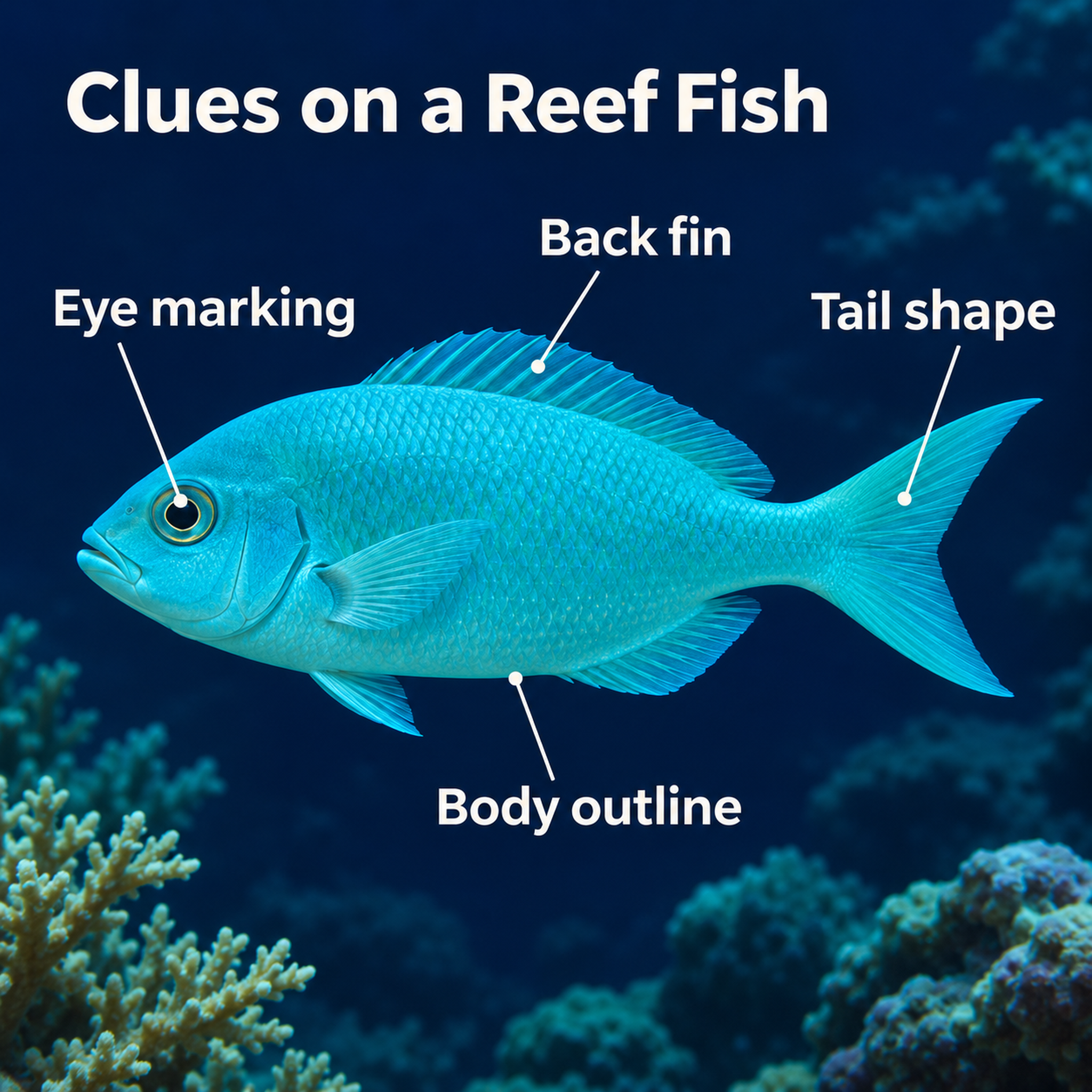
Start with the fish's outline, then check where its marks sit. The shape of the fins, a stripe through the eye or spots near the tail can narrow your choices.
What to look for on the face, fins and tail
Imagine a yellow fish slipping past you on a reef. You catch a dark area around its eye and get one brief look at its side. A yellow body gives you several candidates. The shape and position of the dark mark give you something more specific to compare. Did the mark form a patch that extended behind the eye? Did it look like a bar cutting across the eye? The direction of the lines on the body can help settle the match.
Start by describing the part of the fish you saw clearly. A fish viewed from the side might look tall and flat, long and slender, or rounded with a blunt head. Check the fin along its back, called the dorsal fin, and the shape of the tail. The narrow part just before the tail fin is the tail base. A spot there tells you something different from a spot on the tail fin itself.
Quick reference by the clue you remember
Use the first column to find a likely group, then check another feature before choosing a species.
| What caught your eye | Candidate | Second clue to check | Where to compare |
|---|---|---|---|
| Yellow body and a dark mark by the eye | Butterflyfish | Blue-grey cheek patch or a black eye bar with a white band behind it | Yellow and striped fish |
| Dark horizontal stripes on a reef fish | Sohal surgeonfish | Orange mark at the tail base | Yellow and striped fish |
| Orange body with two white bands | Two-band anemonefish | One band behind the head, another across the middle | Anemonefish and habitat |
| Rounded fish with a dark face | Masked puffer | Pale gap between the eye mask and mouth patch | Puffers, barracuda and lionfish |
| Long, silvery body | Barracuda candidate | Head profile, fin positions and any dark flank markings | Puffers, barracuda and lionfish |
| Fan-like side fins and long spines | Lionfish | Reddish-brown bands on a pale body | Puffers, barracuda and lionfish |
Pick one candidate and check a second feature in the same view or photo. If the head is hidden or the tail has moved out of frame, save your first impression as a possible match.
Yellow and striped fish around coral
A yellow fish with a blue-grey patch around the eye fits bluecheek butterflyfish. A black eye bar backed by a white band and diagonal body stripes points towards diagonal butterflyfish.
Bluecheek and diagonal butterflyfish
The bluecheek butterflyfish (Chaetodon semilarvatus) has a bright yellow body crossed by fine reddish-orange lines. Its blue-grey patch covers the eye and extends behind it. The patch can look almost black in a shaded photo. If the colour is hard to judge, zoom in on the shape of the patch and check whether the body lines run close to vertical. A Hurghada coastal lagoon survey recorded the bluecheek butterflyfish, so there is local evidence for including it in the guide.
The diagonal butterflyfish (Chaetodon fasciatus) also has a yellow body. Look for dark lines that slant across its side and a black band through the eye. A white band sits immediately behind that black band. That light edge gives you another clue if the fish turns and the lines on its flank disappear from view. From above, the fish may present only a narrow slice of its body. If you saw yellow and little else, keep the identification open.
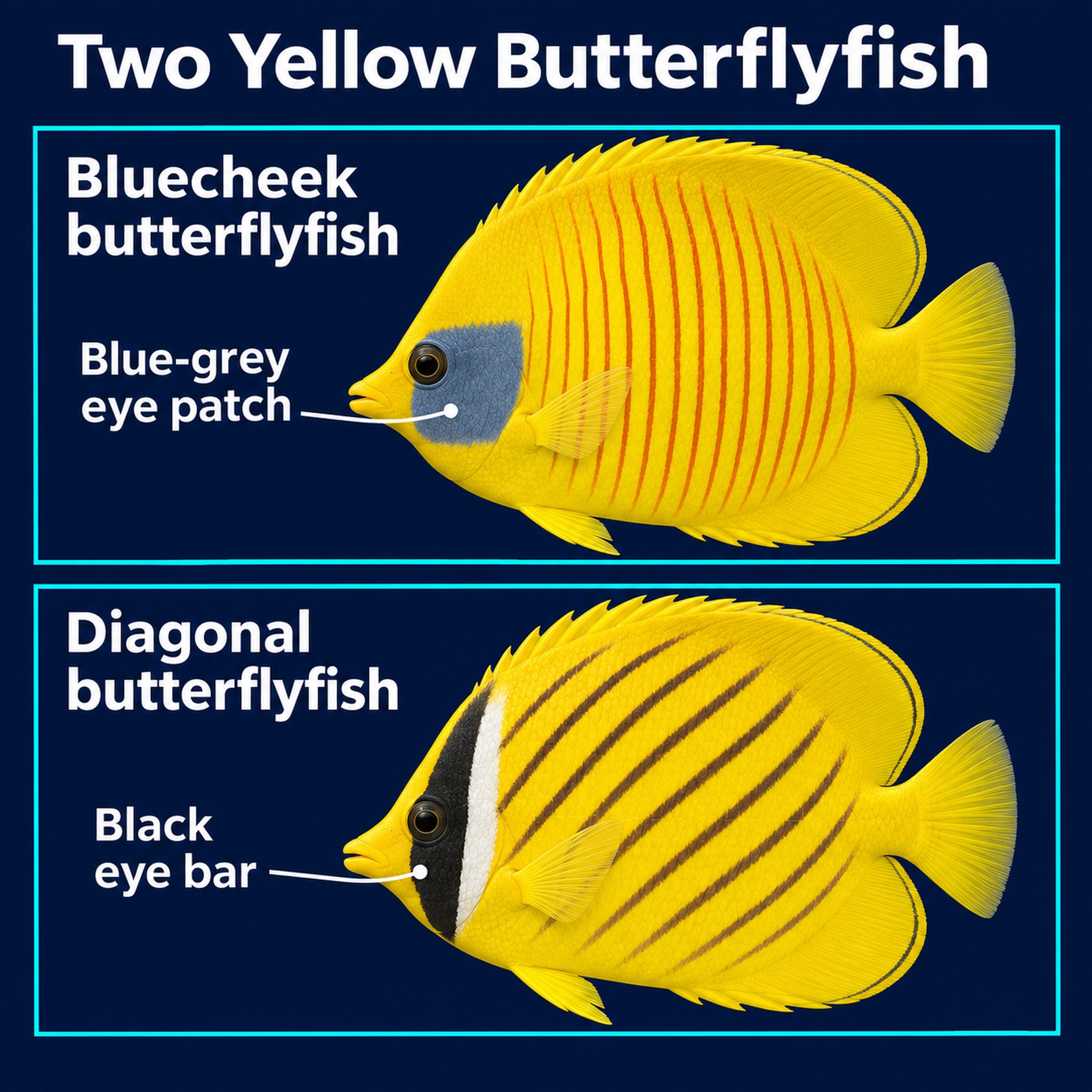 When comparing two photos, look at the eye first. Then follow the lines from the back down the side. The face and the flank together are more informative than the overall shade of yellow. A clear image of either feature offers a better comparison than a close crop of the brightest patch of colour.
Sohal surgeonfish and Indian sailfin tang
The sohal surgeonfish (Acanthurus sohal) has dark stripes running horizontally along the sides. Look for orange at the tail base and, on an adult, a crescent-shaped tail. A distant view may leave you with the stripes alone. If the photo shows the back half of the fish, check the base of the tail for orange before settling on the name. The Indian sailfin tang (Zebrasoma desjardinii) is also a surgeonfish. The back fin rises high when the fish spreads it, giving the body its sailfin profile. Adults have vertical bars, with spots lower on the body. The pattern changes as the fish matures, and a folded fin can make the outline look less striking. Compare the direction of the bars before relying on the height of the fin. Hurghada's lagoon survey recorded both fish. A local record gives you useful candidates to compare with your photo.
Anemonefish and the habitat clues around them
A small orange fish with two white bands beside an anemone fits the two-band anemonefish. Look for one band behind the head and another across the middle.
Two-band anemonefish near an anemone
The two-band anemonefish (Amphiprion bicinctus) has an orange to yellow-orange body. Its two white bands have dark edges. The first band sits immediately behind the head. The second crosses the middle of the body. A fish turning among tentacles may show just one band at a time, so try to remember where the bright band sat. An anemone is a useful clue because the fish lives in association with a host. A photo with the fish and part of the host in frame records more than a tight crop of the fish's face. If the fish stays partly hidden, remain where your guide has asked you to swim and watch from there. The fish and the tentacles sometimes offer a clearer view as they move. The survey recorded the two-band anemonefish in a Hurghada lagoon. A photographed observation at Gota Abu Ramada also shows one with its host. Either record is useful when you compare a sighting, while the route and visibility on the day shape what you see in the water.
Coral gardens, ledges and the water beside a reef
Notice where the fish was just before you lost sight of it. Was it beside an anemone, beneath an overhang or out in the water beyond the coral? Those are useful details to add alongside the colour and shape. If you photograph a fish under a ledge, include enough background to show that setting. Your view also changes with your position in the water. From the surface, a tall, narrow fish can look like a thin line. From the side, the same fish shows where the bars start and end. You may get a useful match simply by waiting for the fish to turn. Our guide to Hurghada dive sites describes coral gardens, walls and other reef settings. Use the guide to decide what sort of underwater view interests you, then ask about the route your group will take.
Puffers, barracuda and lionfish
Masked and white-spotted puffers
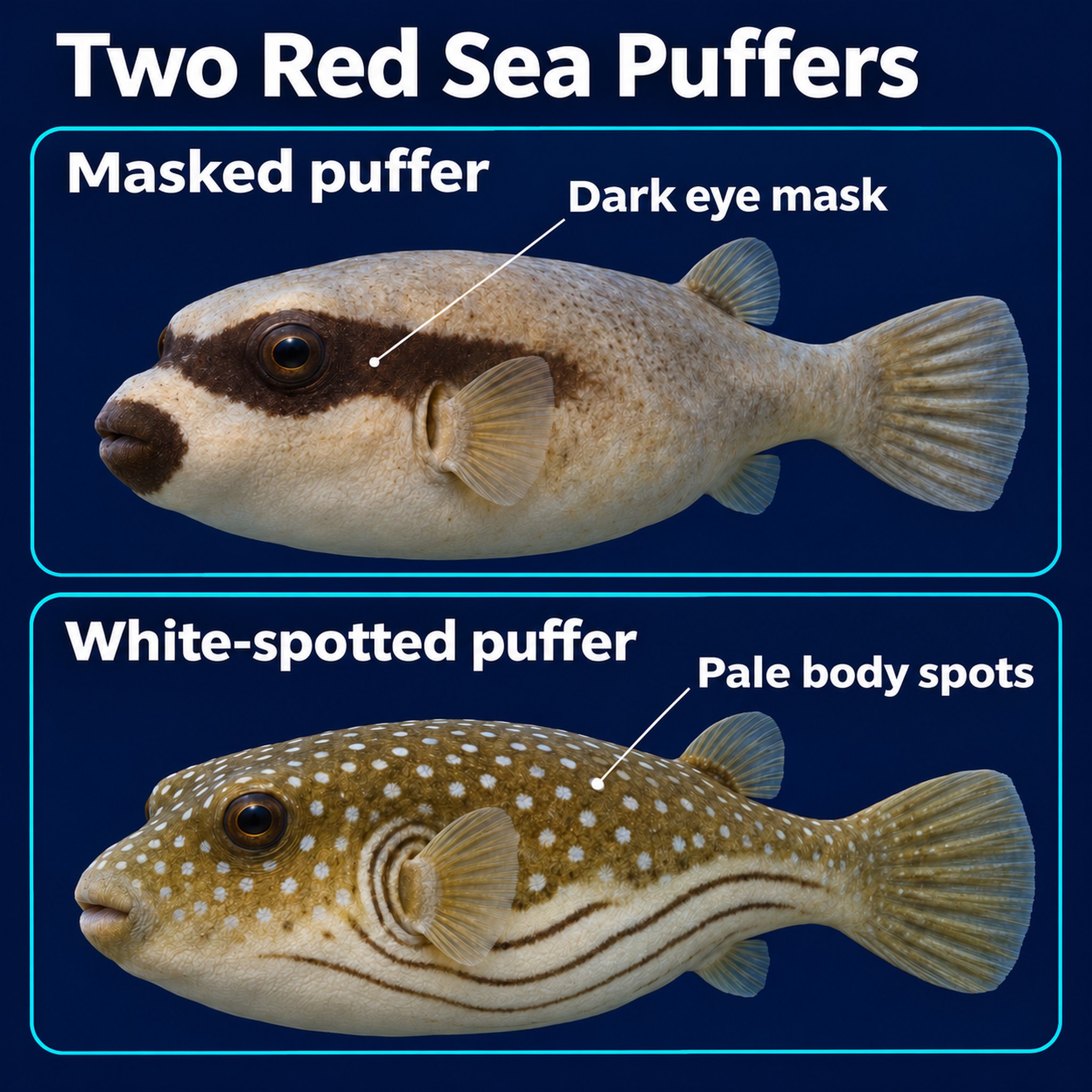
A masked puffer (Arothron diadematus) has a dark band across the eyes and a separate dark area around the mouth. A pale gap usually makes the two marks easier to distinguish. Some individuals also show spots on the body. Look at the head pattern first, especially if you saw a pale fish with what looked like a dark face.
A white-spotted puffer (Arothron hispidus) has small pale spots across the upper body. Curved dark lines mark the lower body, and rings sit around the base of the side fin. From the surface you might see the spots and lose the lines below the fish's widest part. A side view offers a better chance of seeing both parts of the pattern.
Compare the two puffers by looking at where the strongest marks sit. On a masked puffer, check the eyes, the pale gap and the mouth. On a white-spotted puffer, look at the body above and below the side fin. Puffers have enough shape and colour to check while swimming normally. Leave the fish space and never try to make it inflate.
Great barracuda and uncertain silver silhouettes
A long, silvery fish off the reef is easy to remember and harder to name from a fleeting view. A great barracuda (Sphyraena barracuda) has an elongated head and body, with dark slanting bars along the upper sides. Several irregular black blotches often appear low on the rear flank. The bars and blotches are worth checking if you have a clear side view. Distance and angle can hide those markings. Look for a distinct head profile and note where the fins sit along the body. If the shape suggests a barracuda but the flank markings are indistinct, “possible barracuda” is a useful record. You can describe the fish to your guide and ask what other details would narrow the match. Regional records establish the great barracuda as a Red Sea species. A particular Hurghada sighting still depends on the clues you saw.
Lionfish with long spines and fan-shaped fins
A lionfish often stands out by its outline before you see its pattern. Look for wide, fan-like side fins and long spines along the back. The devil firefish (Pterois miles) has reddish-brown bars on a pale background. Other lionfish share some of those features, so keep “lionfish” as your identification if the view is brief. A photo that shows the head, the fins and their markings gives a reviewer more to work with. Lionfish have venomous spines. Observe from a distance and keep your hands and fins clear, especially around a ledge where there is less room to manoeuvre. If the fish disappears into cover, let it go. The same space gives you time to see any markings that emerge without disturbing the animal. Our guide to sharks in Hurghada covers shark identification and encounter guidance separately.
Fish photos and reef-friendly observation
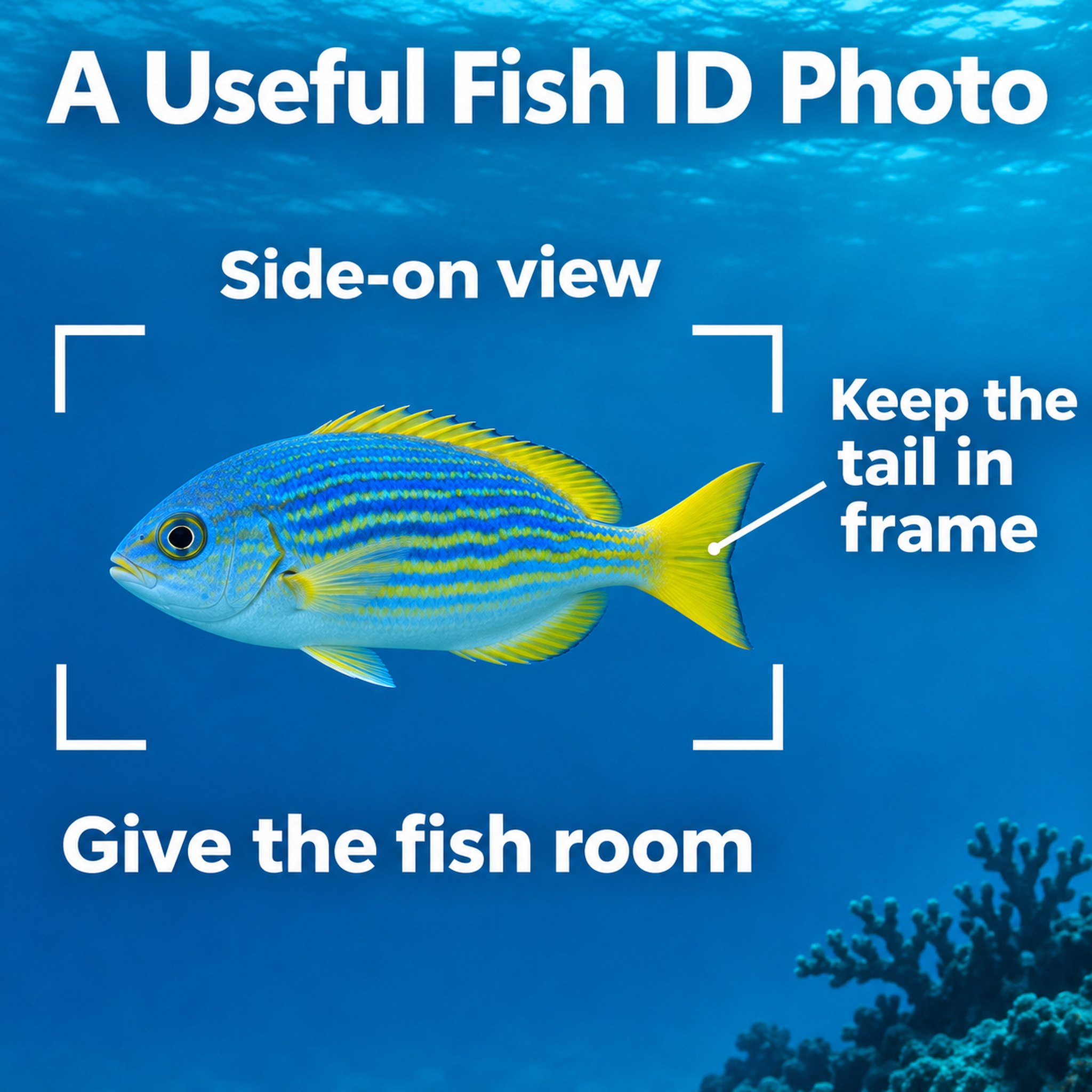
A side-on photo that shows the eye, fins and tail makes fish identification easier. Stay back, let the fish swim freely and keep your fins clear of coral.
A side-on photo and a short sighting note
Frame the whole fish if the view allows, with enough space around the tail and nose. A clear photo from farther away can retain more useful detail than a tight shot taken as the fish turns. If a fish passes beneath you, wait to see whether it swims into a side view. Keep your position and follow your guide's instructions for the site. For divers, good buoyancy control on Red Sea dives helps keep fins and equipment away from coral while you watch.
 After the outing, jot down the reef or site name, the date and the approximate depth if you know it. Add the setting and the mark that stood out. A note such as “yellow fish with a dark bar through the eye beside a coral head” gives your guide a clearer starting point than “small yellow fish”. Keep a note of any details you remember that the camera missed.
The Egyptian Chamber of Diving & Watersports' responsible snorkelling guidance recommends passive observation and keeping fins clear of the reef. Let fish move freely and avoid touching, feeding or chasing them. Give yourself room to float without standing on coral, and leave an overhang undisturbed if a fish swims out of sight.
When the fish family is the best answer
If your only photo shows the tail, describe what the photo supports. You might be able to compare a fin shape but have little evidence for a species. Keep a qualified note such as “probably a butterflyfish, eye not visible”. A partly obscured image can still help a guide explain which feature to look for on the next outing. When your photo and memory seem to disagree, keep both clues in the note, with their source. Maybe you remember a pale gap around the face but the photo shows only the flank. That combination can guide a closer look at the original image or another frame from the same sequence.
Reef outings for different experience levels
Snorkelling for a surface view
If your aim is to recognise a few fish from the surface, start with a guided snorkelling route where the day's conditions suit your group. Ask where the guide expects to enter and where you'll spend time over the reef. A plan with room to float and watch gives you time to notice the direction of stripes or the mark on a tail. For a group with different swimming confidence, ask how the guide plans the route and what options people have between stops. Browse Blue Reef's snorkelling outings for a starting point. Before you choose, tell the team who wants to snorkel and what each person is comfortable doing in the water. Ask about the planned reef setting if seeing fish is a priority for the group. The route and conditions will help you decide what sort of view to expect.
Introductory scuba and guided diving
If you want to see the reef from below the surface and you've never used scuba gear, an instructor-supervised introductory experience gives you time to get used to the equipment and learn basic skills. The briefing and practice take priority. Save the fish guide for a look beforehand or for comparing what you remember afterwards. If you want to work towards a certification, choose a diving course based on your experience and how much time you want to spend learning. If you're already certified, tell us how recently you dived and what sort of reef view interests you. You might prefer a route where you have time to watch fish around coral heads. Ask what the planned route offers and whether it fits your recent experience and the day's conditions. Your dive guide can explain where to keep an eye out and when to give the group your full attention.
Frequently asked questions
Can you identify Red Sea fish while snorkelling?
Yes, when the water gives you a clear view of the fish. Start with large markings and body shape. Try to see the fish from the side so you can check where a band or patch sits.
What is the yellow fish with a blue patch near its eye?
A bluecheek butterflyfish is a strong candidate. Look for a blue-grey patch that covers and extends behind the eye, plus fine reddish-orange lines down the yellow body. If the fish has a dark eye bar with a sharp white band behind it, compare the diagonal butterflyfish.
Is every long silver fish a barracuda?
Several fish have long, slender bodies. Compare the head shape, fin positions and any markings low on the rear flank. “Possible barracuda” is a reasonable note if all you saw was a distant silhouette.
Which Red Sea fish should you keep your distance from?
Give all reef wildlife room and keep your hands and fins clear of lionfish spines. Avoid reaching under ledges or into crevices to get a closer look.
What should I note if I have no photo?
Write down the body shape, the position of the strongest marking, the tail shape if you saw it and where the fish was swimming. Ask your guide which detail would help confirm the match. For your next outing, pick a few markings to look for and bring back a photo or a short sighting note. If you're a certified diver planning time on the reef, check diving prices and booking to see Blue Reef's guided diving options.

Leave a comment