


Sharks in Hurghada are a real part of the Red Sea ecosystem, yet a normal beach visit or local dive does not come with a predictable encounter. Habitat, distance from shore, current conditions and activity all matter. This guide explains which sharks are documented in the region, how local reefs differ from remote offshore sites, what visitors should understand about safety, and how to respond calmly to a sighting.
Are there sharks in Hurghada?
Sharks occur in the Red Sea around Hurghada, but their presence does not make sightings predictable. Most visitors on ordinary local outings will not have a guaranteed encounter.
The Red Sea supports many shark species, from reef-associated animals that rest near coral shelter to wide-ranging open-water species. A regional species record answers one question: an animal can occur in the wider area. A record does not answer a visitor's next question: will a shark appear on a particular beach, boat trip or dive?
Hurghada also contains more than one underwater setting. Sheltered reefs, outer walls, open water and distant offshore reefs each have different depths, currents and food webs. A shark that uses a remote drop-off may have little relevance to a shallow local reef. A day with good visibility may still produce no shark sighting, while an unexpected encounter can happen on another day.
The most useful expectation is simple. Treat a shark encounter as wildlife, not an inclusion. When planning a dive, start with the kind of reef, route and experience level that suit you. The Hurghada dive-sites guide can help you frame that conversation.
Sharks visitors may encounter around Hurghada
The Red Sea has a wide variety of sharks, but a broad regional list should not be read as a Hurghada sighting forecast. The species below help visitors understand the main groups mentioned in local conversations and safety briefings.
| Species or group | Useful identifying clue | Broad habitat association | What the record means for a Hurghada visitor |
|---|---|---|---|
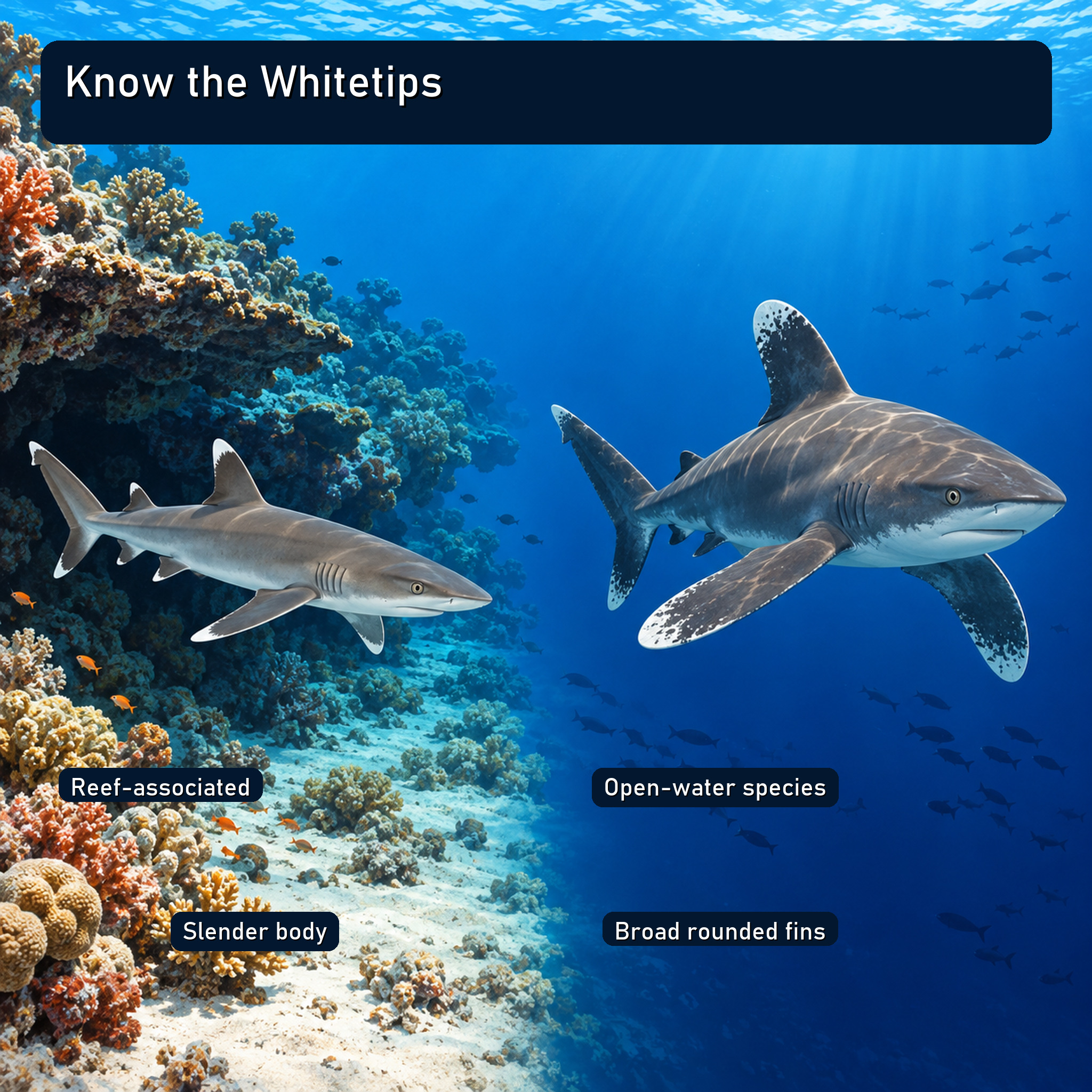
| Whitetip reef shark | Slender body with white fin tips | Coral reefs, crevices, caves and lagoons | A reef-associated shark, not a guaranteed local sighting. |
| Grey reef shark | Dark marking along the tail edge | Reef walls, drop-offs and current-exposed areas | More relevant to deeper or outer-reef settings than a sheltered beach. |
| Blacktip reef shark | Dark tips on several fins | Shallow reefs and reef flats | A small reef shark group that can use shallow coral habitat. |
| Oceanic whitetip shark | Long, rounded pectoral fins and a broad dorsal fin | Open water, offshore reefs and drop-offs | A distinct open-water species that deserves a specialist briefing when present. |
| Whale shark | Large spotted body and broad mouth | Open water and plankton-rich conditions | A rare and memorable regional visitor, never a promised Hurghada activity. |
| Tiger shark | Broad head and dark markings that can fade with age | Coastal and open-water environments | The species confirmed in the 2023 Hurghada fatal incident. Presence in the region does not predict another encounter. |
Scientific records also need careful reading. A sighting database can show that a species was observed, when an observation occurred and the setting around the record. The same database cannot prove that a species appears every week, at every reef or on a visitor's planned route. Researchers use repeated observations, photographs, location details and other methods to build a clearer picture over time.
The Red Sea is also large. A species recorded at a southern offshore reef, a marine park or a deep-water survey station may be far from the reefs used on a Hurghada day trip. A useful local guide should name that limit plainly instead of turning every regional record into a holiday expectation.
Two names cause regular confusion. A whitetip reef shark and an oceanic whitetip shark are different species with different habitat associations. The reef species commonly rests close to coral shelter. The oceanic species is adapted to open water and may approach divers more closely. A guide should explain the conditions and the species when an oceanic whitetip is relevant to a planned dive.
Grey reef sharks, blacktip reef sharks and whitetip reef sharks are often discussed in connection with coral reefs. The phrase does not mean every coral garden contains a resident shark. A reef has many routes, depths and microhabitats. A dive team also needs to make decisions around weather, current, group experience and the day's plan.
Whale sharks occupy a separate category. A whale shark is the world's largest fish and feeds by filtering small food from the water. A whale shark's size can make a sighting feel dramatic, yet a large animal still needs space. Do not chase, touch or crowd a whale shark for a photograph.
Tiger sharks and oceanic whitetips attract the most attention after headlines. Both species deserve respect. Neither species should become shorthand for every shark in Hurghada. The wider Red Sea is not one uniform habitat, and a local encounter remains difficult to predict.
Local reefs and remote Red Sea shark sites
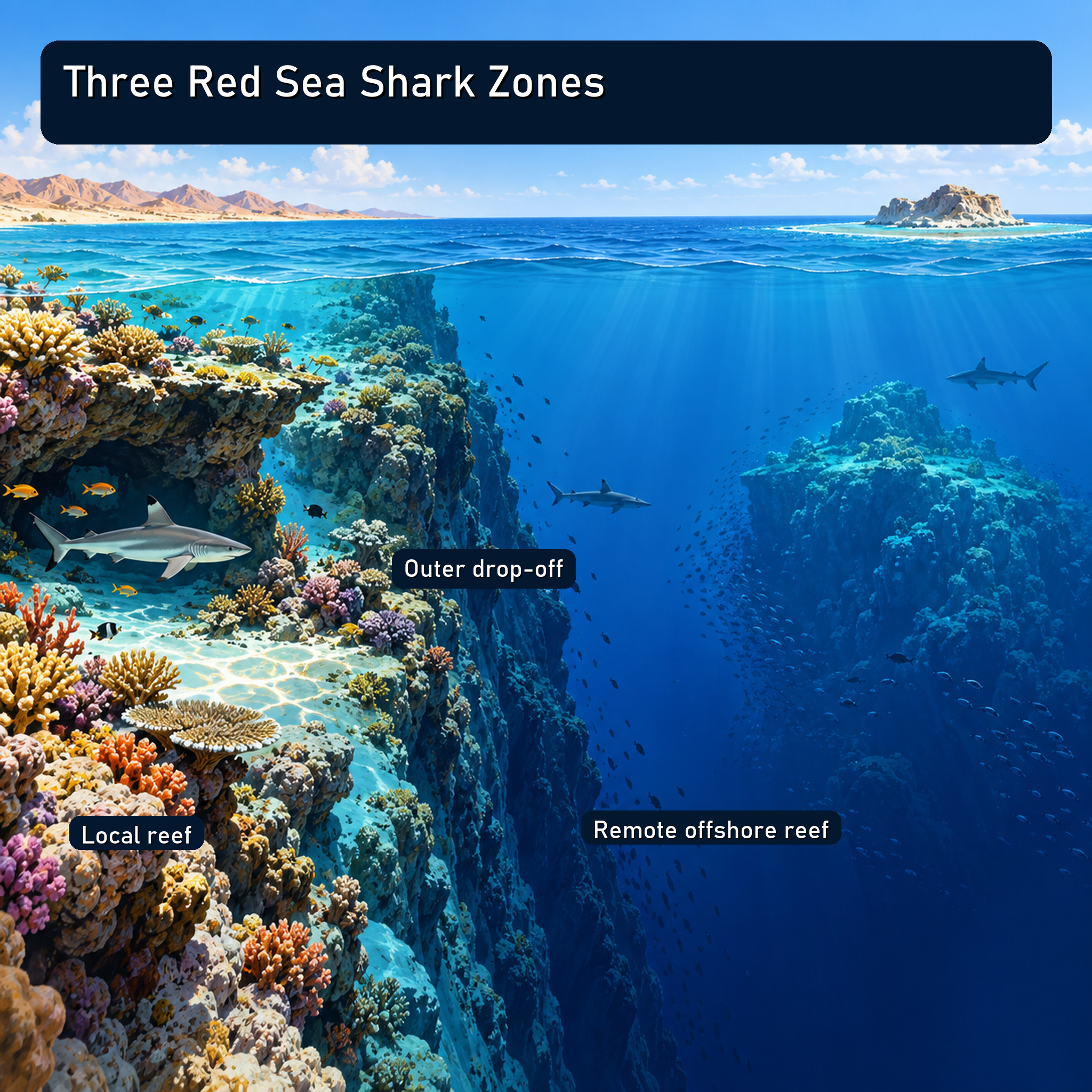
Hurghada's local reefs are not the same setting as remote offshore reefs. Habitat, depth, currents and distance from shore change which sharks may be present.
Local reef settings
Local reef dives often focus on coral gardens, reef detail, walls or calmer routes chosen for the group. A local reef can still produce an exciting wildlife sighting. A shark should remain a bonus rather than the reason to disregard the proposed dive profile.
Blue Reef's dive-sites directory shows how varied local terrain can be. A site name alone does not describe the exact route, depth or conditions. A suitable plan begins with your training, recent experience and comfort in the water.
Outer walls and drop-offs
Outer walls and drop-offs are transition areas between a reef and deeper water. Those areas may have stronger current or a more exposed position. Reef-associated sharks and passing open-water animals can use such settings, but a wall does not create a wildlife guarantee.
The important decision is not whether a wall sounds more exciting. The important decision is whether the proposed route suits the group on that day. Ask what the entry, current, depth range and alternative plan look like before making a choice.
Remote offshore reefs
Famous shark locations in the Egyptian Red Sea are often remote offshore reefs rather than everyday Hurghada routes. Reaching such places can involve longer travel, liveaboard arrangements or more demanding conditions. A visitor should not assume that a holiday based in Hurghada includes the same experience.
That distinction protects both expectations and safety. A traveller who wants reef scenery, wrecks or a gentle introduction to scuba can choose a local plan. A diver with a specific interest in larger open-water sharks needs a separate discussion about route, conditions and appropriate experience.
Shark seasons and sighting uncertainty
No verified source supports one dependable shark season for every Hurghada site and every shark species. Seasonal patterns can exist, yet a pattern for one species or one part of the Red Sea does not become a booking promise for another location.
Whale-shark research in the southern Red Sea shows that some animals return to a particular aggregation area during a recurring part of the year. The finding is useful science because researchers recorded the location over time using several methods. The finding does not establish that whale sharks arrive near Hurghada on a fixed calendar.
The same caution applies to advice about hammerheads, tiger sharks, oceanic whitetips and reef sharks. Temperature, prey, currents, weather and the available habitat can influence animal movement. Researchers still need long-term observations to understand local patterns. A single sighting, a holiday photograph or a memorable dive story cannot prove a season.
Ask a dive centre about current conditions and realistic site options instead of asking for a guaranteed shark month. A professional can explain whether the day's route is a local reef, an exposed wall or another setting. A professional cannot schedule a wild animal.
Is it safe to swim, snorkel and dive in Hurghada?
Shark bites remain rare, but no open-water activity is risk-free. Follow current closures and local instructions because swimmers, snorkellers and divers face different conditions.
Egypt's Environment Ministry confirmed that a tiger shark caused a fatal incident involving a beach user in Hurghada on 8 June 2023. Authorities surveyed the water and temporarily stopped swimming, snorkelling and water-sport activities across a defined section of coast. The tragedy deserves clear context and respect for the person involved. The event does not establish that every beach or dive site carries the same level of risk today.
Historic headlines cannot replace current information. An official closure takes priority over a hotel plan, an online article or a familiar-looking sea. Beach staff, lifeguards, boat crews and dive professionals may have more current guidance for a particular location. Follow that guidance without trying to judge the water from shore.
Risk also has more than one layer. A rare event can still be serious, especially when people ignore a closure, separate from a group or act around wildlife as though the animal is part of an attraction. At the same time, a frightening video or an old headline does not describe every day in the Red Sea. A good decision uses the current local briefing, the planned activity and a realistic view of wildlife.
Swimming, snorkelling and scuba diving also place people in different positions. A swimmer may spend more time at the surface close to shore. A snorkeller may move along the surface or over a reef. A scuba group can follow a planned route below the surface with a guide, yet scuba equipment does not remove the need for awareness or professional direction.
Avoid two unhelpful reactions. Panic can make an otherwise manageable situation harder. Casual behaviour can ignore a powerful wild animal and the instructions designed to protect people. The useful middle ground is calm preparation: check local notices, choose an activity that suits your confidence and stay ready to follow the briefing.
Readers who are new to scuba should not use shark anxiety as a reason to skip a conversation about training. A structured diving course can help a beginner understand basic procedures, group awareness and comfort in the water before planning more demanding dives.
What should you do if you see a shark?
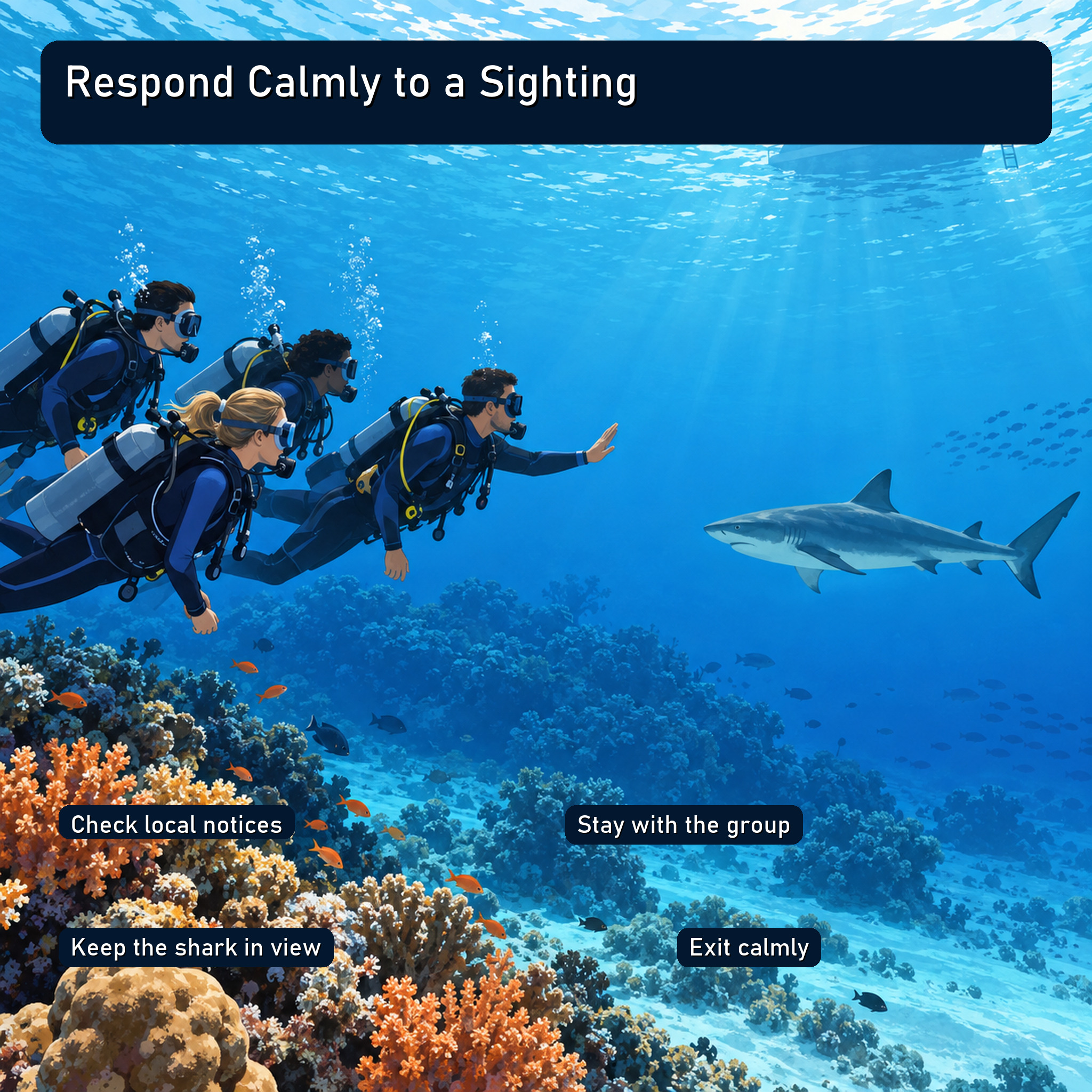
Stay calm, keep the shark in view, remain with your group and follow the responsible professional's instructions. Never chase, touch, feed or surround the animal. Generic online tips cannot override an official notice, a lifeguard or a guide who can assess the actual setting. The following sequence gives a useful starting point for a sighting during a beach activity, snorkel or guided dive.
- Check who is responsible for the group and follow that person's direction.
- Keep the group together and avoid sudden splashing, chasing or crowding.
- Watch the shark without moving closer for a better view or photograph.
- Leave the water calmly when a professional instructs the group to exit.
- Report the sighting through the appropriate boat crew, dive centre or beach authority.
A swimmer or snorkeller should leave the water when instructed and avoid returning until the responsible local authority says the activity can resume. A diver should stay close to the guide and buddy, maintain calm control and follow the agreed exit plan. The correct action may differ between a reef dive, a surface snorkel and a beach situation.
Oceanic whitetips need special mention because the species can approach divers in open water. Egyptian diving guidance advises detailed briefings, group awareness and controlled surface procedures where the species may be present. Those procedures are not an invitation to seek a close encounter. A diver should ask the guide how the team will manage the site before entering the water.
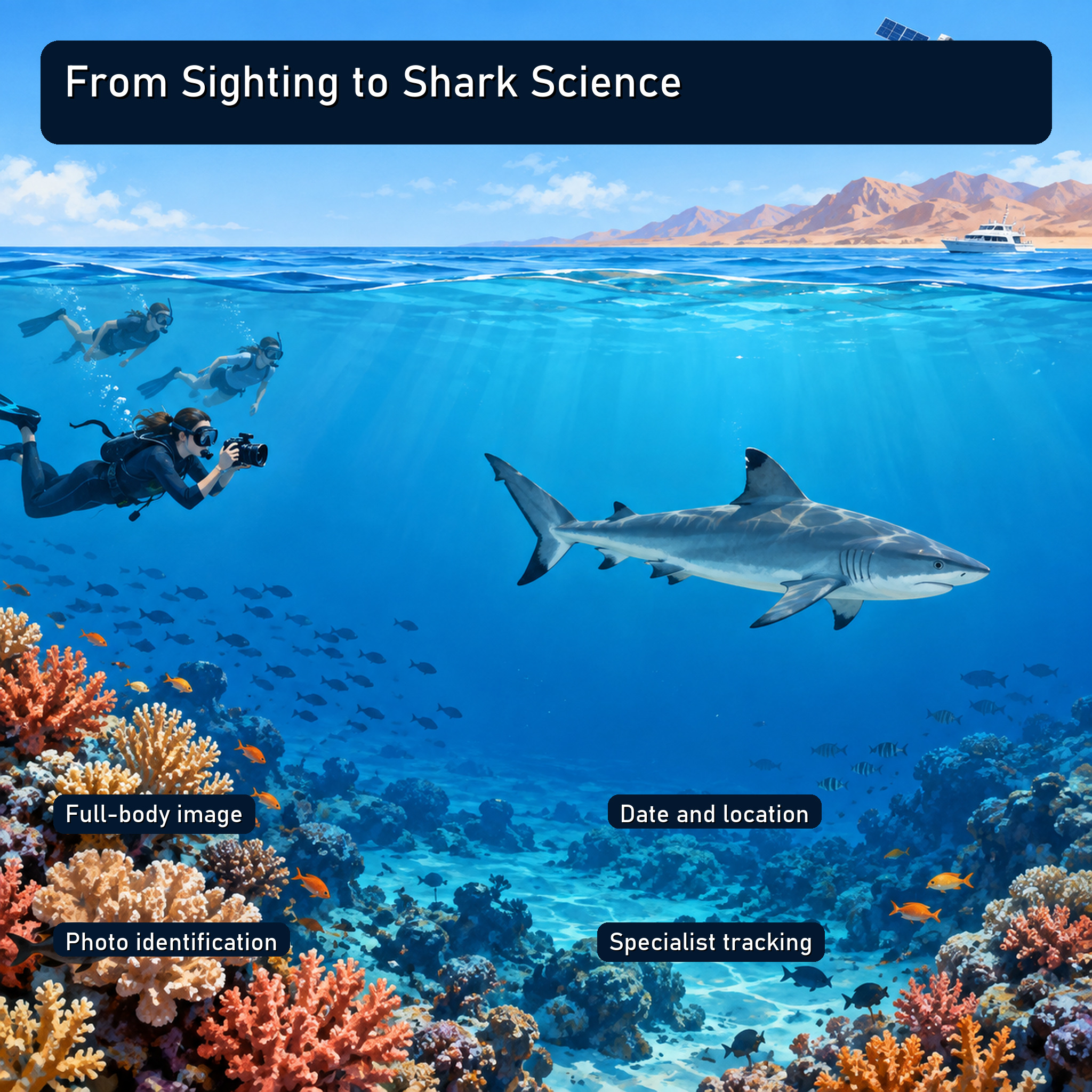
Photography can assist research when a safe opportunity exists. A full-body image with visible fins can help identify a shark, especially when the image includes the date and location. Safety comes first. A photographer should never separate from the group, block an exit or approach a shark for a record.
Good buoyancy control helps a diver stay level, avoid reef contact and move with control. Buoyancy skills are useful on every dive, not only when a shark appears.
Planning a Hurghada trip without shark promises
A good Hurghada water plan begins with your interests and comfort, not a wildlife promise. Reef colour, fish life, wreck history, photography, a first underwater experience or more challenging terrain can all be valid priorities.
The clearest questions are usually practical. Ask which route the team is considering, what conditions could change the destination and whether the group plan suits your recent experience. A useful answer should describe the activity rather than rely on a broad label such as "all levels". A newly certified diver, a diver returning after a long break and a non-certified guest need different conversations. Before you contact a dive centre, prepare the details that help a guide recommend a realistic outing:
- Your certification level and recent diving experience.
- Whether you plan to swim, snorkel or scuba dive.
- Your comfort with current, depth and open water.
- The marine life or underwater scenery that interests you most.
Those details give the dive team a clearer picture than a request for the best shark site. The day's conditions and group plan still shape the final choice. A change from an exposed reef to a more sheltered site can be the right decision, not a disappointing substitute.
If you want to discuss realistic diving options in Hurghada, contact Blue Reef with your experience, interests and travel dates. Blue Reef can help you plan around suitable conditions while keeping wildlife encounters in their proper place: a possibility to respect, never a promise to sell.
Frequently asked questions
Are there sharks near Hurghada beaches?
Sharks occur in the wider Red Sea around Hurghada. A regional record does not predict a shark at a particular beach. Follow current local advice before entering the water.
What is the most likely shark to see while diving in Hurghada?
No species can be promised. Reef-associated sharks such as whitetip reef sharks are more relevant to coral habitat than larger open-water species, but a sighting still depends on the route and conditions.
What time of year are sharks in Hurghada?
There is no verified all-species, all-site season for Hurghada. Some sharks have seasonal patterns elsewhere in the Red Sea, yet visitors should ask about current conditions rather than rely on a fixed calendar.
Can beginners dive with sharks in Hurghada?
Beginners should choose a dive or introductory activity based on training, confidence and the planned conditions. A shark sighting is never guaranteed and should not determine a beginner's site choice.
Can a Hurghada dive centre guarantee a shark sighting?
No responsible dive centre can guarantee a wild-shark sighting. A professional can discuss the type of dive, current conditions and realistic marine-life possibilities for the day.

Leave a comment