


Hurghada dive sites can look equally tempting when every description promises colourful reefs and plenty of fish. Choosing becomes easier when you compare the kind of dive each place offers. A coral garden, a steep wall and a deeper wreck call for different conversations with your dive centre.
The shortlist below covers seven local options, followed by Abu Nuhas for separate wreck-trip planning. Use the comparison to identify your interests, then confirm a suitable route. “Beginner” also needs explaining: a newly certified diver and someone trying scuba for the first time need different arrangements.
Choosing the best Hurghada dive sites
The best Hurghada dive sites match your experience and interests, with the actual route, current conditions and boat plan shaping each choice.
These selections highlight different experiences rather than rank one reef above every other reef. The questions are a planning aid; the linked site profiles below explain the supporting details.
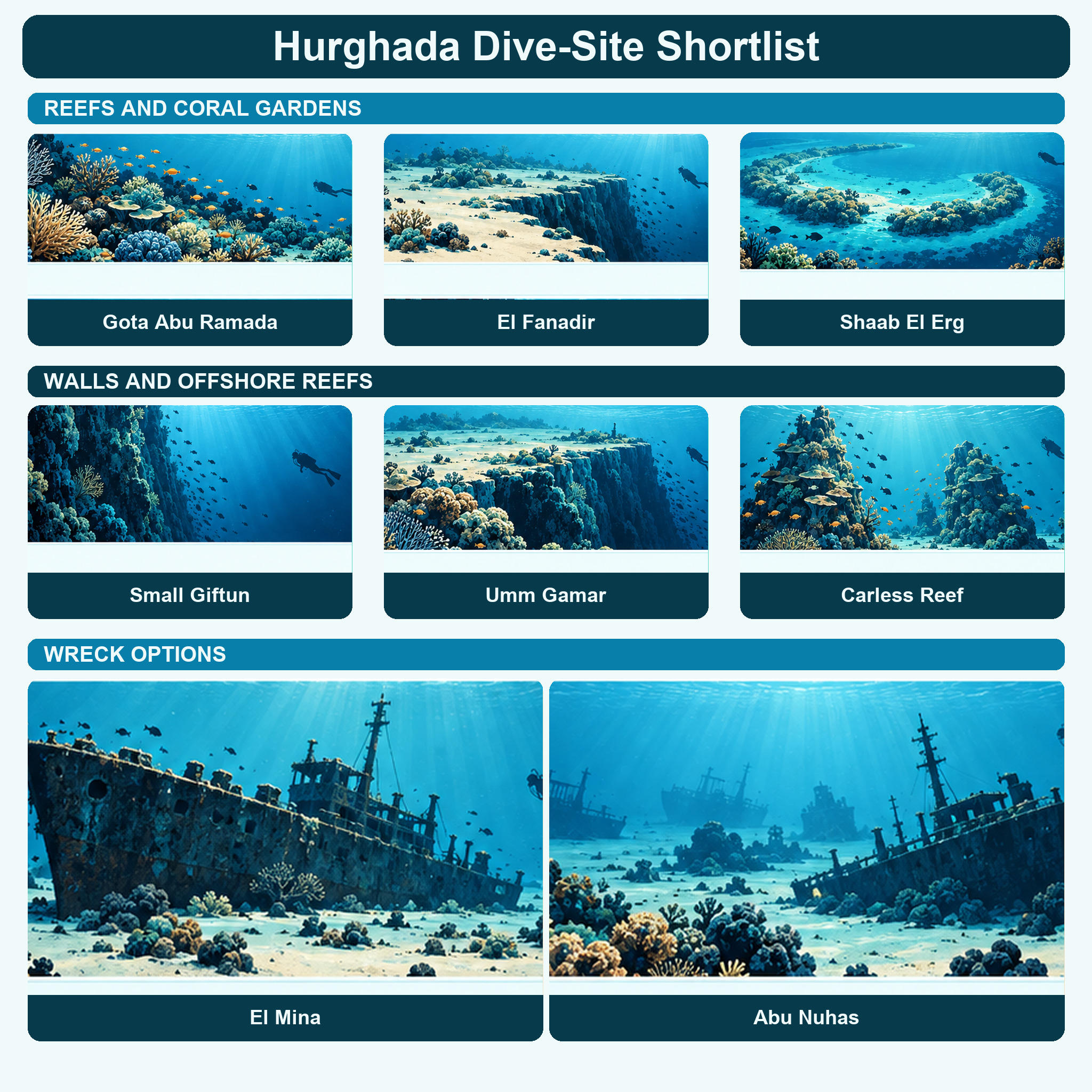
| Dive site | Main appeal | What to confirm |
|---|---|---|
| Gota Abu Ramada | Coral gardens | Which section fits your recent experience? |
| El Fanadir | Reef detail | Will the route stay in shallower areas or approach the drop-off? |
| Shaab El Erg | Dolphin habitat and reef | Which reef and route does the outing visit? |
| Small Giftun | Wall scenery | What experience does the planned dive require? |
| Carless Reef | Offshore reef formations | What alternative is offered if wind prevents access? |
| Umm Gamar | Plateau and wall options | Which side and route will the group explore? |
| El Mina | Deeper wreck | What depth and experience requirements apply? |
| Abu Nuhas | Wreck group | Does the booking cover a dedicated departure or itinerary? |
The table is a conversation starter, not a universal suitability chart. Operators can use different entry points and profiles at the same reef. Weather, current and the group also affect the plan. A shallow feature does not make every route around a reef suitable for every diver. PADI advises consulting a professional familiar with the site and present conditions.
Start by choosing the underwater landscape that matters most to you. Coral gardens suit readers who enjoy close observation and a relaxed visual focus. Walls create a stronger sense of scale and open water. Wrecks combine a physical structure with historical interest, but the available profile may demand different preparation. A dolphin habitat adds possibility rather than certainty.
Next, compare the practical question in the final column. Each question exposes information hidden by a destination name. “Small Giftun” describes an area, while the briefing defines the dive. “Abu Nuhas” describes a wreck location, while the itinerary determines whether the trip fits your dates. The distinction makes the table useful even when the crew recommends another site.
Tutor's Tip: Give the dive centre your last dive date as well as your certification. The team needs to understand your recent experience.
Reefs for coral gardens and close-up detail
Gota Abu Ramada for coral gardens
Gota Abu Ramada is a useful starting point for divers comparing coral gardens, with the chosen reef section determining the actual dive profile.
CDWS describes the coral gardens known as the Aquarium and highlights the site as a learning option.
Consider Gota Abu Ramada when your priority is enjoying reef scenery rather than collecting a deeper dive. Tell the guide whether you prefer a slower pace for observation or photography. Describe your interests with a request such as “I want time to look closely at the reef.”
Coral gardens reward patience. Small reef fish, coral shapes and the way sunlight reaches a sandy bottom can provide much of the interest. Divers who want that pace should say so before the guide plans the group. A request for reef detail is clearer than asking for the “best” site.
Confirm the exact site name, too. A booking mentioning Abu Ramada should specify which reef or section is planned.
El Fanadir for reef detail
El Fanadir deserves a closer look if you want to compare shallower reef features with a site that also has deeper terrain. The El Fanadir North description hosted by PADI identifies a shallow lagoon, a coral wall and sandy areas. The same description includes a drop-off extending into deeper water.
A drop-off is where the seabed falls more steeply. Its depth does not tell you the depth of the proposed dive Ask whether the group will explore the shallower reef or follow a route towards deeper features. For a returning diver, that distinction is more useful than a single “all levels” label. The North profile also should not be treated as a description of every Fanadir dive.
Good buoyancy helps a diver hold position without contacting the reef or stirring sand. Blue Reef's buoyancy control tips explain the skill in more detail. Photography interests are also worth mentioning because a slow close-up route and a steady drift can feel very different.
Shaab El Erg for reef scenery and dolphin habitat
Shaab El Erg combines reef diving with dolphin habitat, but sightings are never guaranteed and the site offers more than one possible route.
The PADI-hosted Shaab El Erg profile describes a horseshoe-shaped reef commonly called Dolphin House. Think of the destination as a reef dive where dolphins may be present.
Shaab El Erg's familiar nickname can dominate expectations. Wild animals choose where they travel and when they surface. The honest promise is a reef outing in dolphin habitat, not a scheduled performance.
A useful question before booking is: would you still enjoy the outing without a dolphin encounter? If the answer is yes, you are choosing the reef as well as the possibility of wildlife.
Did You Know? Dolphins use reefs around Hurghada as resting places. HEPCA's dolphin guidance advises visitors not to chase, touch or feed them.
For companions who are not diving, explore Blue Reef's marine activities. Confirm the actual destination and activity: a Dolphin House excursion name does not establish the scuba itinerary.
Walls and offshore reefs for dramatic scenery
Small Giftun for wall scenery
Small Giftun appeals to experienced divers seeking wall scenery, with the specific route and local assessment helping determine whether the outing suits you.
A wall is a steep underwater reef face. CDWS highlights Small Giftun's walls and sea fans, with an emphasis on experienced divers.
Choose this option for discussion when underwater scenery interests you and you can describe your relevant experience. Ask about the planned entry and current conditions before deciding.
Be specific about “Giftun” when making an enquiry. A general island name leaves room for misunderstanding about the intended dive. Request the named site and route rather than assuming every outing around the islands offers the same experience.
A drift dive uses water movement to carry the group along a planned line. Entry, exit and group control therefore matter. The guide should decide whether the day's current and the diver's experience support the proposed approach. Readers interested in building relevant skills can review Blue Reef's Advanced Open Water course, without assuming a course guarantees access to a site.
Carless Reef for offshore coral formations
Carless Reef, also written Careless Reef, features two coral towers described by CDWS. Wind can limit access to Hurghada's exposed sites.
Put Carless on a preference list rather than treating the name as a guaranteed stop. Ask the operator what happens if the planned destination becomes unsuitable.
If Carless is your main reason for booking, establish how destination changes affect the arrangement before paying.
An alternative site is not automatically a lesser day. A sheltered reef can offer more comfortable observation when an offshore location is exposed. Ask how the crew balances your preferences with weather and group needs. That answer reveals more than a promise to visit one famous name.
Umm Gamar for plateau and wall options
Umm Gamar offers plateau and wall scenery, so ask which route is planned rather than assuming every dive has the same difficulty.
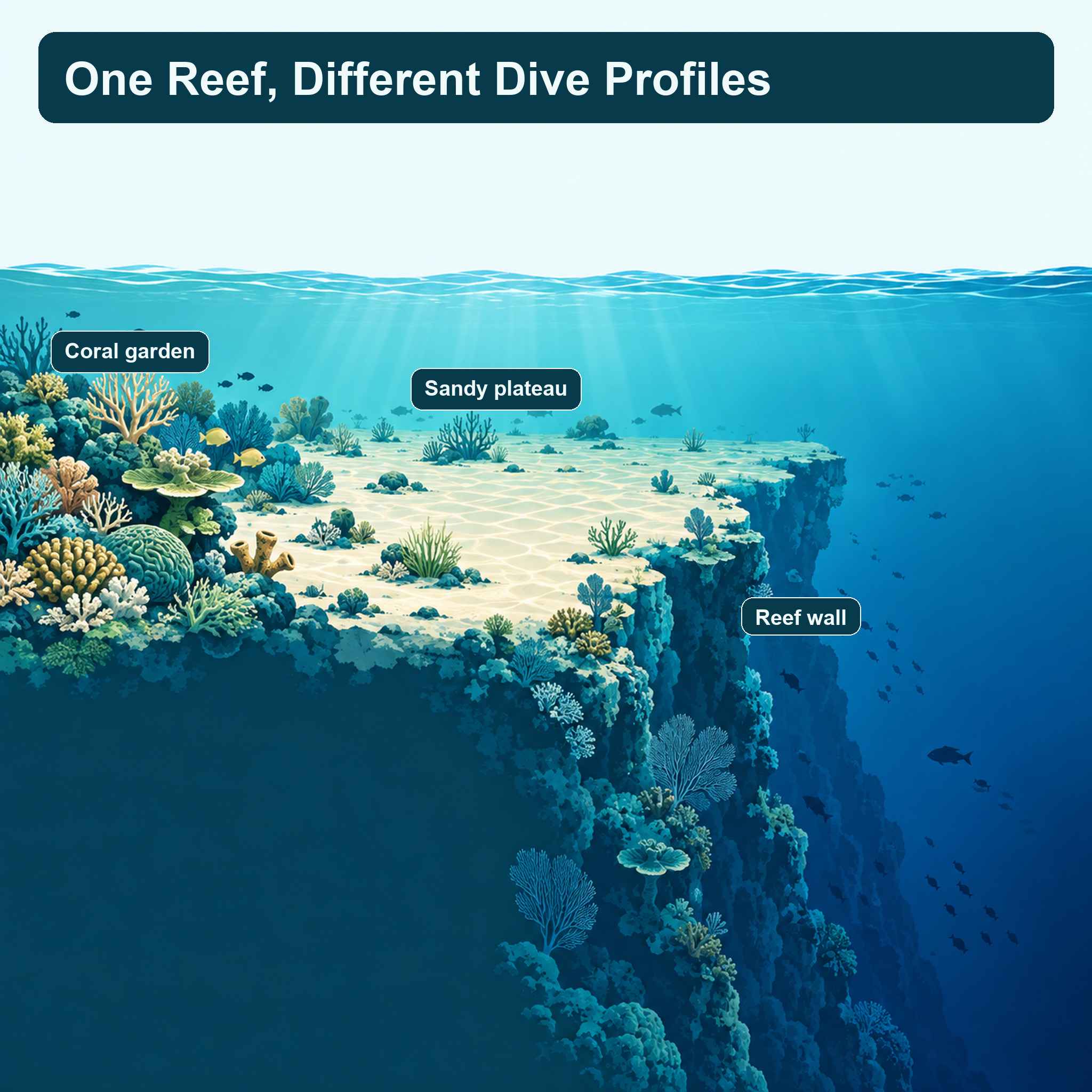
The PADI-hosted Umm Gamar description distinguishes a southern plateau from the eastern wall and its soft coral formations. A plateau is a relatively level underwater shelf.
That distinction gives you a precise question: is the planned outing focused on the plateau, the wall, or both? Share your comfortable depth range and recent experience so the answer relates to your needs.
For a scenery-focused shortlist, compare Umm Gamar with Small Giftun. Discuss the actual proposed routes before choosing between them; the site names alone cannot settle which dive better matches your experience.
Plateau and wall are landscape terms, not certification labels. The plateau may create opportunities for a different profile, while the wall supplies the visual drama. Your guide still needs to match the particular route to your limits and the group plan.
Wreck options near Hurghada and farther north
El Mina for a local wreck dive
El Mina is a deeper wreck option near Hurghada, making the planned depth, current and your recent diving experience central to trip suitability.
The PADI-hosted El Mina wreck description places the wreck on a seabed sloping roughly from 25 to 32 metres. The description also notes that current can be strong.
Those figures describe the setting, not a target depth or permission to exceed your limits. Ask what the proposed dive would involve for you.
Be clear about your interest in seeing a wreck from outside. Entering enclosed spaces is a different activity and should never be assumed part of a sightseeing dive. If a deeper profile does not suit your training or confidence, choose a reef outing instead of letting the wreck's appeal decide.
Wreck interest can mean history, structure, marine growth or photography. Tell the centre what attracts you. Seeing a vessel from open water differs from entering an overhead space, where direct access to the surface may be restricted. This guide does not provide penetration guidance.
Abu Nuhas for a dedicated wreck trip
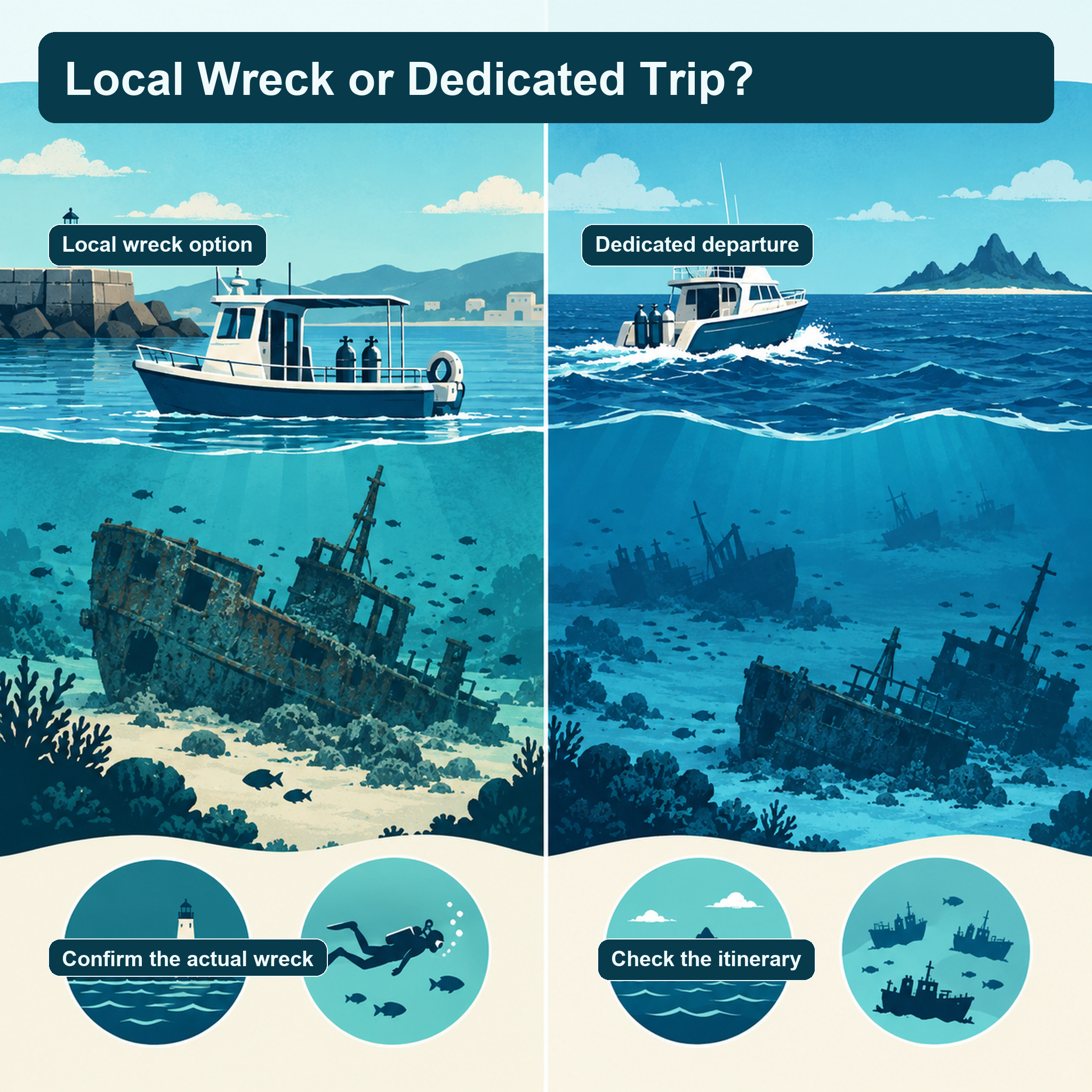
Abu Nuhas belongs in a separate wreck trip discussion, because reaching the wreck group requires confirming the departure plan, conditions and operator arrangements.
 CDWS identifies four well-known wrecks along Abu Nuhas:
- Giannis D.
- Carnatic.
- Chrisoula K.
- Kimon M.
A request for “Abu Nuhas” still leaves the specific wreck undecided. Ask which wrecks the operator proposes and what experience each planned dive requires.
CDWS also describes extended wreck itineraries departing from Hurghada. An extended itinerary may involve a liveaboard, a boat where divers stay overnight. Do not assume those arrangements are included in a standard local reef package.
A dedicated outing may be worth considering when wrecks are the main purpose of the holiday. A local reef day may be a better fit when time is limited or when a mixed group prefers varied scenery. Neither choice is inherently better. The value depends on what the trip actually includes.
Before comparing prices, confirm the departure point and schedule. A journey time quoted for a different resort or marina may not describe your trip.
Match the route to your recent diving experience
Certification cards tell an operator what training a diver completed. They do not show recent practice, current confidence or comfort in moving water. Share those details plainly. A long gap does not lead to one automatic answer, but the information helps a professional suggest an appropriate next step.
Copy and complete these six fields when enquiring about a dive day:
- Certification and restrictions: ___
- Last dive and recent experience: ___
- Comfort with currents and deeper dives: ___
- Preferred scenery and two or three sites: ___
- Travel dates and accommodation: ___
- Equipment needs and non-diving companions: ___
For example, imagine two certified friends choosing a day together. One has recently completed several dives; the other has not dived for two years. Both want coral scenery, but neither should assume the same route is automatically suitable. They could enquire about Gota Abu Ramada or El Fanadir while asking how the centre assesses returning divers.
If you have never dived, discuss an introductory experience or Open Water training before selecting a certified-diver outing. For further skills development, explore advanced dive training. Once the centre suggests an option, confirm:
- The proposed route, depth and experience requirements.
- When the destination is chosen and how alternatives are handled.
- The full price, inclusions and any extra charges.
Tutor's Tip: A shortlist gives the team useful preferences. The day's conditions still determine which options are suitable.
Turn your shortlist into a practical trip enquiry
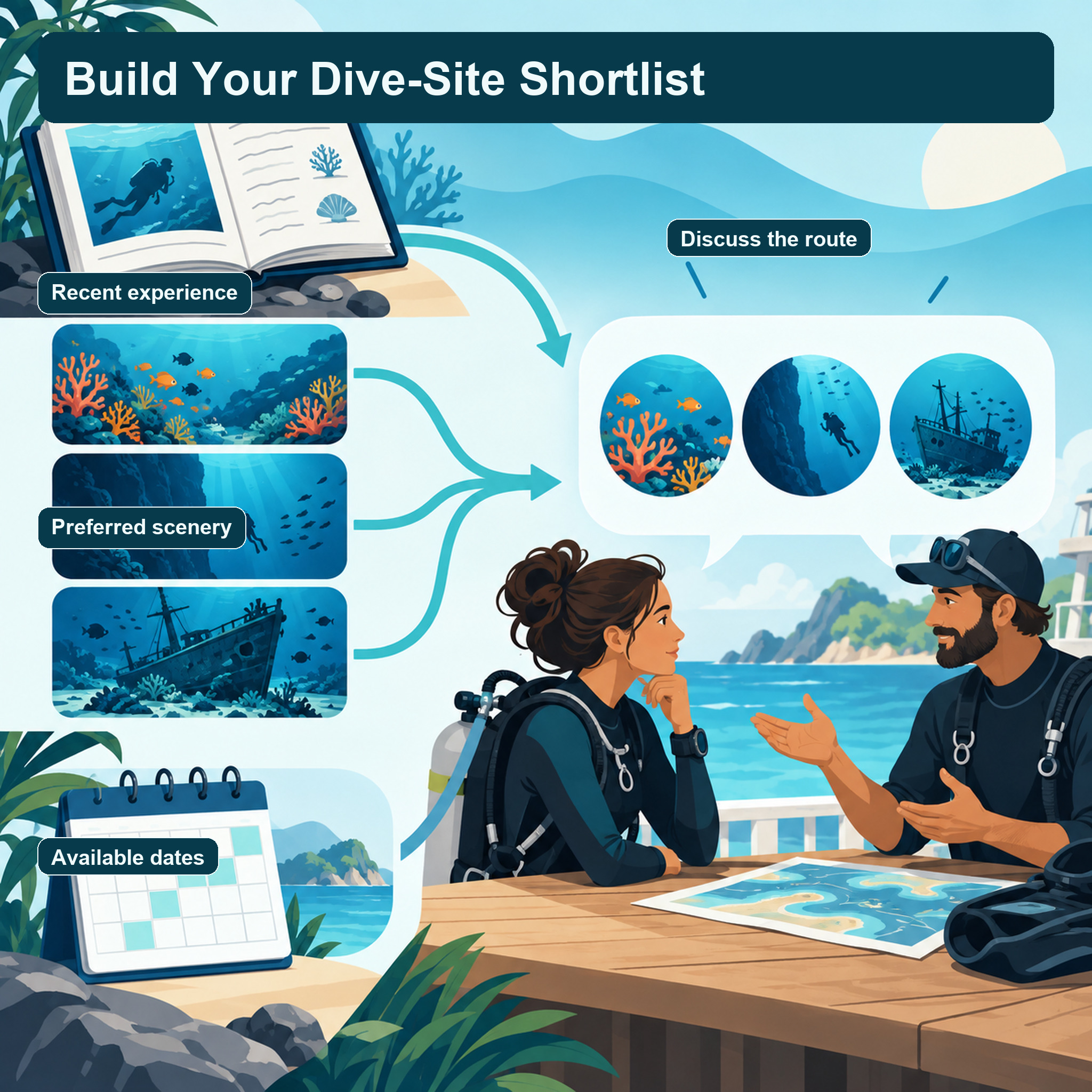 Start with the experience you hope to enjoy, then choose a small number of sites to discuss. You might want a leisurely reef observation dive, a wall landscape or an outside view of a wreck. State that preference clearly, together with your current training and confidence.
The most useful booking conversation ends with an understood plan, including what can change. Ask when the final destination is normally decided. Also ask whether the choice may change after the boat leaves. Clear expectations prevent a preferred-site request from becoming an assumed guarantee. Keep wildlife expectations flexible and leave room for the local team to assess conditions.
Send the enquiry early enough for the centre to understand the group. Mention non-diving companions because their activity may require a separate arrangement. State equipment needs rather than assuming every package has the same inclusions. Ask for the complete current price only after the centre understands the requested activity. That order helps both sides compare the same service.
When the response arrives, check whether the suggested outing answers your priorities. A suitable reply should identify the type of dive, explain any requirements and describe how destination changes are handled. Ask one follow-up question when a detail remains unclear. A short, accurate exchange is more useful than a long list of famous sites.
Compare Blue Reef's diving packages, then discuss your shortlist. Confirm which destinations are available for your dates and which proposed outing fits your experience.
Frequently asked questions
Which Hurghada dive sites are suitable for beginners?
Newly certified divers can discuss Gota Abu Ramada or shallow El Fanadir routes, while non-certified beginners need an introductory programme or course.
Which Hurghada dive site is best for coral gardens?
Gota Abu Ramada is a useful coral-garden choice, but the best outing also depends on the planned route, conditions and your preferences.
Are dolphins guaranteed at Shaab El Erg?
Dolphins are never guaranteed at Shaab El Erg, so choose the outing for reef diving and treat any wildlife encounter as a bonus.
Are Hurghada wreck dives suitable for every diver?
Hurghada wreck dives do not suit every diver; the proposed depth, conditions and activity must match your training and recent experience before booking.
Can I choose the exact dive sites before booking?
You can request preferred dive sites, but confirm how the operator selects destinations and handles changes when conditions or group requirements affect plans.

Leave a comment