


El Mina Wreck Hurghada raises practical questions before you plan a dive. How deep is the wreck, what happened to the ship, and does the site suit your experience? This guide examines the published history, explains reported depths and outlines the conditions to discuss with a local dive professional. You will also learn how to distinguish a wreck's deepest point from your own planned diving limits.
What is the El Mina wreck and where is it?
El Mina is a former Egyptian Navy minesweeper near Hurghada Harbour. Also identified as Minya, the wreck is a site for divers interested in naval history. Egypt's Chamber of Diving and Water Sports identifies the vessel as a Soviet T-43 minesweeper. Its Minya wreck profile places the ship close to the harbour, resting on its port side. Port means the ship's left side when facing towards the bow. For a visitor, the main attraction of the El Mina wreck dive site is recognising a ship beneath the water. An exterior view can connect the outline of the hull with the vessel's former purpose. Approach the visit as a chance to observe a historic structure, with the route chosen around your experience. These published details provide a starting point for an enquiry:
| Detail | Reported information | What to clarify before visiting |
|---|---|---|
| Name | El Mina, also identified as Minya | Specify the Hurghada wreck when enquiring |
| Setting | Near Hurghada Harbour | Confirm the departure point and access arrangements |
| Depth | Around 30 m; a published seabed range reaches 32 m | Ask for the planned maximum depth |
| Conditions | Strong current is possible | Request a current assessment from the guide |
| Trip availability | Not established by a general site description | Ask whether a visit is available on your dates |
The depth range and current description come from PADI's El Mina wreck listing. These are site descriptions, not a forecast for your trip. If you are still deciding what kind of diving you want, explore Blue Reef's Hurghada dive sites. Use the wider selection to discuss alternatives with your guide, especially when members of your group have different interests.
The history behind El Mina and the name Minya
The name El Mina is familiar to divers, but the historical account needs more precision. Writing for CDWS, wreck researcher Ned Middleton identifies the ship as Minya and records its sinking by Israeli forces on 6 February 1970. His account notes that information about the action itself is limited. Read the CDWS account of Minya. That distinction matters when reading descriptions of the wreck. A documented sinking date does not establish every detail of the attack. A precise account of aircraft, weapons, crew movements or casualties would need its own reliable evidence. Those details should not be reconstructed from the wreck's appearance alone. The article therefore uses El Mina in the title, reflecting the name readers search for, and Minya when discussing Middleton's identification. When contacting a dive centre, mentioning both names and Hurghada helps make your request clear. History can also shape what you want from the dive. You might be interested in the vessel's outline, surviving equipment or the way a working ship changes underwater. Tell your guide which aspects interest you. A briefing that connects visible features to their original purpose can make an exterior visit more meaningful. Keep the historical account separate from present-day access decisions. A description written about a wreck cannot confirm the condition of every opening or fitting today. The story provides context; a current local assessment determines the visit.
How deep is El Mina Wreck Hurghada?
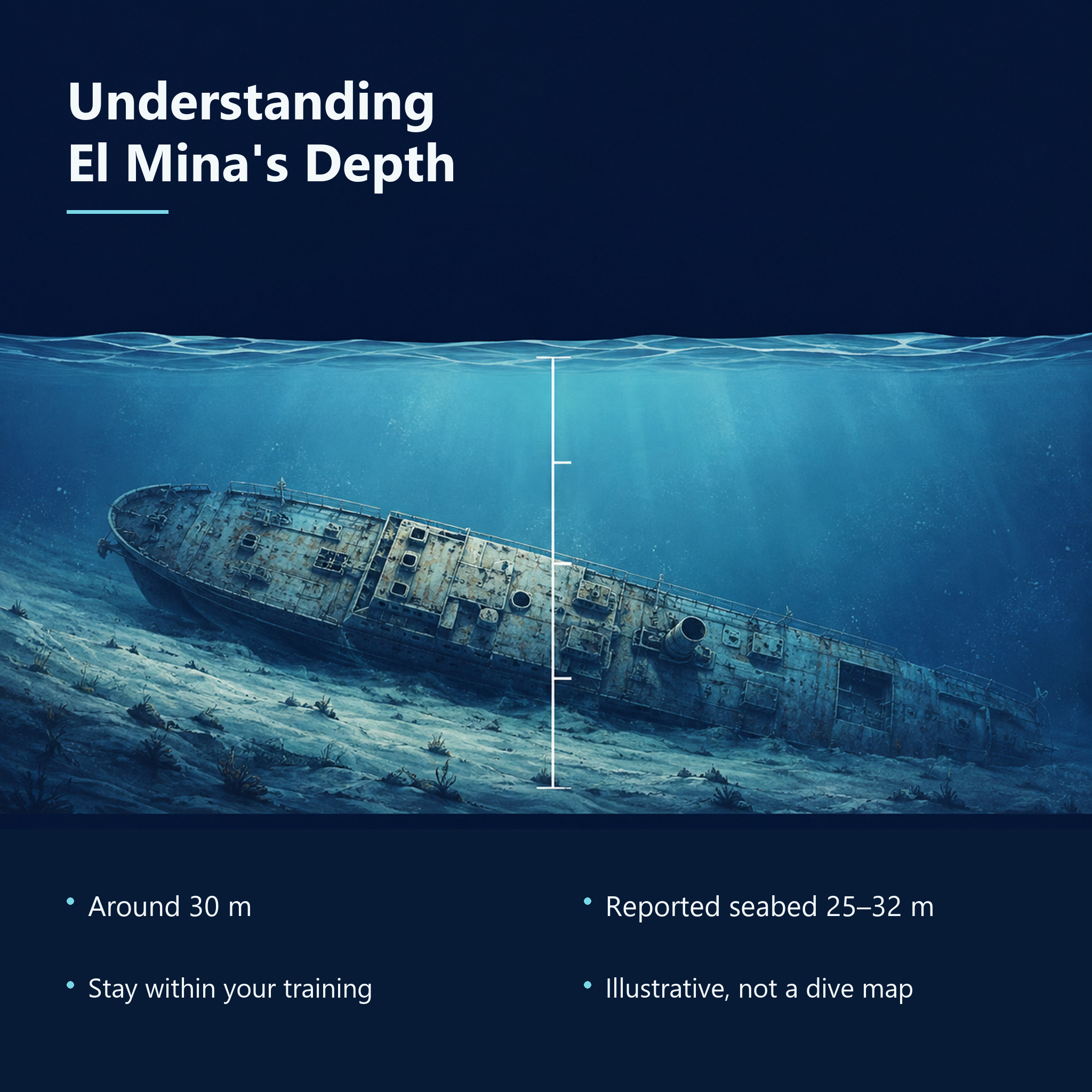
Published descriptions place El Mina around 30 metres deep, with seabed figures extending from 25 to 32 metres. Those figures describe the site, not an individual's permitted dive depth.
CDWS gives a depth of 30 metres. PADI's member-contributed description reports a seabed sloping from 25 metres beneath the bow to 32 metres at the stern. The PADI page's summary also lists 30 metres, so even one listing contains different levels of detail. CDWS depth information, PADI site description.
Read those numbers as approximate descriptions of different parts of the site. They do not establish a guaranteed shallow route or an up-to-date measured profile. Ask the guide where the planned dive will go and how deep that route is expected to reach.
Site depth and your planned maximum
A site's deepest point and your dive's maximum depth answer different questions. The first describes the location. The second sets a boundary for your own plan. Seeing 32 metres in a guidebook does not mean a diver should descend there to complete the experience. For example, consider a diver with a 30-metre training limit who is offered a route reaching 32 metres. The route needs reconsideration before entering the water. A rounded description of the wreck as a 30-metre site does not resolve the mismatch. PADI describes adult Open Water diving to 18 metres and Advanced Open Water diving to 30 metres. Junior qualifications have additional restrictions. Apply the limits relevant to your age, training and experience, rather than using the deepest number printed on a site page. PADI's explanation of diving depth limits.
A depth figure does not provide a dive plan
Depth is only one part of preparation. The planned duration, breathing-gas supply, ascent and buddy arrangements also need agreement. DAN recommends discussing site conditions, entry and exit, communications and contingency plans before diving. DAN's dive-planning guidance. Ask questions until you can explain the proposed dive in your own words. Where will you go, what is your maximum depth, and what would cause the plan to change? If the answers remain unclear, resolve the uncertainty during the briefing. An attractive wreck should not distract from understanding the dive you have agreed to make.
What dive conditions should you expect?
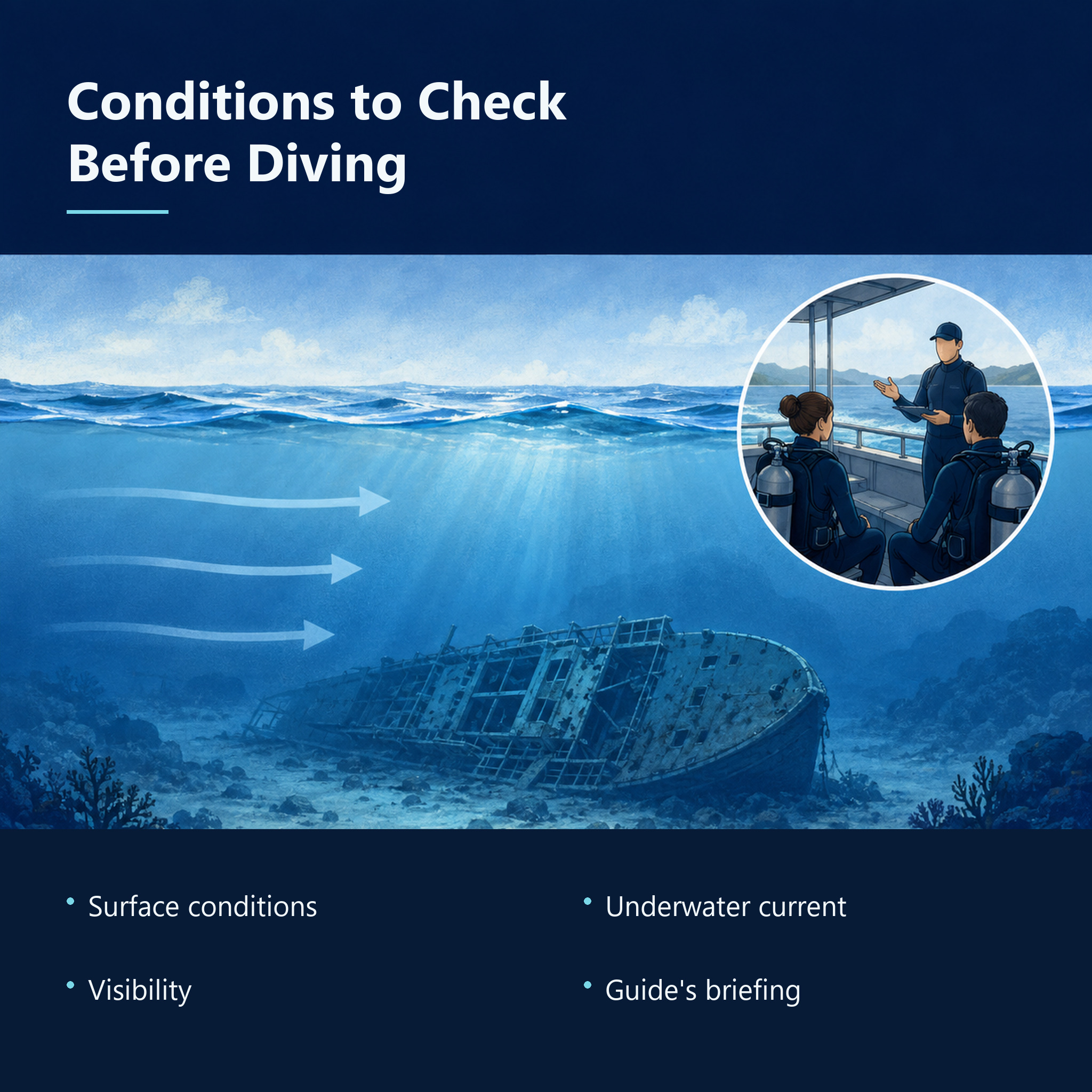
El Mina can have strong current even when surface conditions appear calm. Ask a local dive professional about current, visibility and the planned route before deciding whether to dive. PADI's site description notes potentially strong current from the north. A sheltered-looking surface should therefore not be treated as proof of easy underwater conditions. The same listing advises consulting a professional familiar with the site's present conditions. PADI's El Mina wreck description.
Current can change the experience
Current deserves a specific discussion during the briefing. DAN explains that water movement can differ in speed and direction through the water column. A wreck may interrupt the flow locally, but reaching or leaving that shelter is a separate part of the dive. DAN on diving in currents.
Ask how the guide expects conditions to affect the route, entry and return to the boat. Make your experience clear. Having enjoyed a gentle drift dive does not tell the guide how comfortable you are staying near a fixed structure in moving water.
Useful descriptions are concrete. Explain whether you have dived in current recently and what made those dives manageable or difficult. The briefing can then address your actual experience instead of relying on a broad label such as confident or advanced.
Visibility needs a current assessment
Avoid building expectations around a single photograph of the wreck. A photograph records one viewpoint during one dive. It cannot show what visibility will be like when your group arrives. DAN identifies weather, current, bottom composition and other environmental factors as influences on visibility. Ask for a recent site assessment rather than treating a general visibility range as a promise. DAN's guide to preparing for diving conditions. If seeing the whole ship is your main reason for visiting, tell the guide. If photography matters, explain your expectations before the destination is chosen. The resulting discussion may change your priorities, especially if the available conditions favour a closer exterior view.
Match the day to the diver
There is no single calendar month that settles every suitability question. Ask about expected water temperature and exposure protection for your dates, then confirm actual conditions closer to departure. A seasonal expectation is useful for packing; the local briefing is needed for the dive itself. Review Blue Reef's buoyancy control guide as background for discussing your skills with an instructor. PADI recommends refreshing skills after inactivity and choosing conditions consistent with your experience. PADI's standard safe diving practices.
What training and experience do you need?
Suitability depends on your certification, recent experience and the agreed route. Advanced training does not automatically cover every part of a wreck reported to reach 32 metres. An Open Water qualification alone should not be taken as confirmation that this dive suits you. Start by comparing your training limits with the proposed route. PADI's adult Open Water limit is 18 metres, below the reported seabed depths discussed above. PADI depth guidance. If you want to develop deeper-diving experience, Blue Reef's Advanced Open Water course provides a relevant starting point for an enquiry. Ask about the course itself and suitable training sites. Do not assume that enrolling includes an El Mina visit.
Give the guide a useful picture of your experience
Bring your certification details and recent dive history to the conversation. Describe your usual diving environment and the depth of recent dives. Mention a long break, unfamiliar equipment or a skill you would like to practise before considering the wreck. Two divers with the same card may need different plans. One may have dived regularly in comparable conditions. Another may be returning after a long interval with little recent practice. PADI's safe-diving guidance emphasises training, experience and skill review, alongside local orientation. PADI's standard practices. A useful enquiry describes what you have done rather than declaring that you can handle anything. You might explain that your recent dives were shallow, calm and guided. That information gives the operator a practical basis for discussing preparation or another site.
Exterior viewing and entering a wreck are different activities
Looking at a wreck from open water does not require you to enter its interior. Decide with the guide what the exterior route involves, and keep that agreement clear throughout the briefing. PADI's Wreck Diver course addresses specialist skills such as surveying wrecks and recognising potential hazards. A general advanced qualification should not be confused with completion of specialist wreck training. PADI Wreck Diver course information. DAN also stresses that wreck-diving demands depend on the environment and the type of exploration involved. Several unfamiliar challenges can combine on one dive. Treat experience in depth, current and visibility as relevant individual considerations. DAN on wreck exploration. An exterior visit can be a complete objective. You can be interested in a ship's history without making its interior part of your plan. Discuss what you hope to see, then let the agreed limits shape the experience.
What to look for around the wreck
Start with the ship's overall shape. A vessel resting on its side can be difficult to interpret at first. Ask the guide to identify the bow, stern and deck orientation during the briefing, so the underwater view has context.
CDWS describes surviving winches and weapons among the exterior features. Its account also reports live ammunition. Observe historical objects without touching or disturbing them. CDWS's description of the wreck.
The purpose of recognising those features is understanding, not collecting a complete set of sightings. A route may show only part of the vessel. Ask which features are likely to be visible on the agreed exterior dive, and regard everything else as outside that day's objective.
Give the structure room
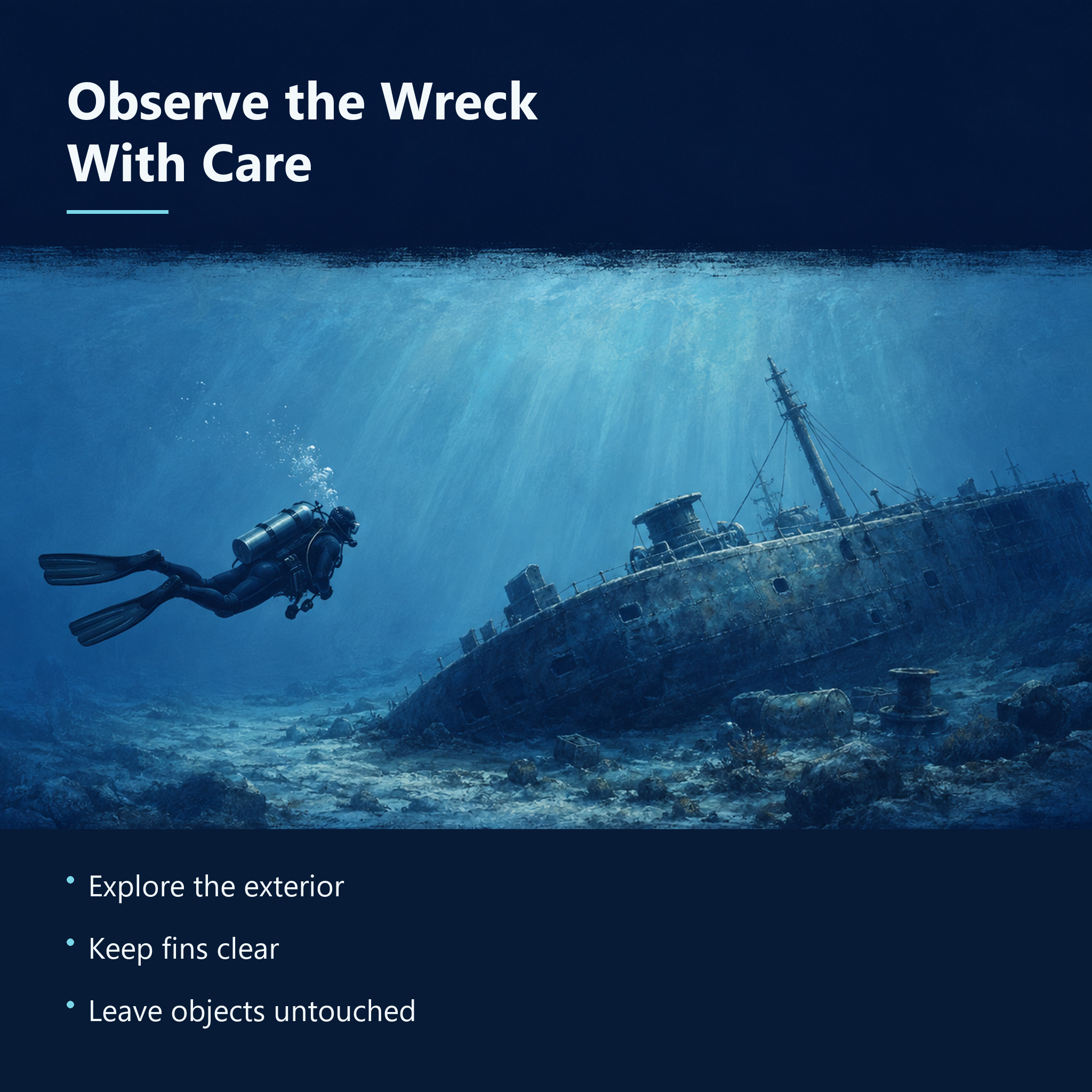
Choose observation and photography positions that keep you clear of the wreck. If a composition would require contact with the structure, choose another view. A close-up photograph is optional; protecting the wreck is part of being a considerate visitor. HEPCA's Save Our Wrecks work highlights the need to protect Red Sea wrecks from damaging use. The programme provides wider conservation context, rather than evidence of a specific project at El Mina. HEPCA's wreck-conservation programme. Ask your guide about local conservation expectations before entering the water. Knowing how the group will move around the site makes it easier to leave space for other divers. Keep your attention on your buddy and position as well as the feature you are viewing. Marine-life sightings can be an additional interest, but avoid making a particular animal the condition for a successful visit. The wreck itself supplies the subject. If animals appear, observe without changing the agreed route or crowding their space. A patient exterior view leaves room for both the historic structure and the surrounding environment.
Planning an El Mina wreck dive with Blue Reef
Begin with your dates, certification and recent experience. Add El Mina or Minya to the enquiry so the team understands your interest. A booking for Hurghada diving should not be interpreted as confirmation of a particular wreck. Before choosing a package, resolve these five questions with the operator:
- Is an El Mina visit available during my travel dates?
- What qualification and recent experience are required for the proposed dive?
- What is the planned maximum depth and exterior route?
- How will current conditions affect the decision to visit?
- What alternative site would suit me if El Mina is unsuitable?
The answers should connect the attraction of the wreck with a realistic plan. DAN recommends agreeing important details and contingencies before diving. Having an alternative destination is part of preparation, rather than a reason to disregard changing conditions. DAN's planning guidance. If your group includes newer divers or non-diving companions, mention everyone at the enquiry stage. Ask which activities can be arranged together and which need separate plans. Clarify package inclusions, equipment arrangements and departure information directly, rather than borrowing details from another excursion. El Mina's appeal combines naval history with a distinctive underwater setting. Understanding the published depth, checking conditions and describing your experience help turn that interest into a sensible choice. Ask Blue Reef about El Mina's availability and suitability, then review the relevant diving packages and booking options.
Frequently asked questions
Are El Mina and Minya the same wreck?
Yes. CDWS identifies the Hurghada wreck known as El Mina as Minya. CDWS's identification.
When did the El Mina wreck sink?
CDWS records 6 February 1970, while noting limited information about the attack. Read the sinking account.
Can an Open Water diver dive El Mina?
Do not assume so. PADI's adult Open Water depth limit is 18 metres, while published El Mina descriptions concern substantially deeper water. Ask an instructor about appropriate preparation and a suitable alternative. A guide's presence should not be treated as a substitute for training. PADI's depth limits.
Do you need to enter the wreck to enjoy the dive?
No. An exterior visit can focus on the ship's shape and visible features. Agree that objective with the guide. Entering a wreck is a separate consideration involving specialist skills and assessment, not an automatic extension of an exterior dive. PADI's wreck-training overview.
Is an El Mina visit guaranteed when booking Hurghada diving?
A general diving booking does not establish that El Mina is included. Ask Blue Reef to confirm whether a visit can be considered for your dates and experience. Discuss the alternative if local conditions or operational arrangements change. Contact Blue Reef before booking.

Leave a comment