

You've done your Open Water course. You know the theory. But thirty minutes into a Red Sea dive, your gauge shows half a tank and your buddy still has plenty. You're kicking hard, tilting head-down, and fighting your gear instead of enjoying the reef. That's not bad luck. That's buoyancy control, and it's the single skill that separates a stressful dive from an effortless one.
Get buoyancy control right and everything else about diving gets easier: your air lasts longer, your body stays level, and you stop crashing into coral you're trying to admire. Most divers never fix this because nobody explains it clearly.
Instructors teach the mechanics in a pool during Open Water training, but the fine-tuning that actually makes buoyancy feel natural usually gets learned the hard way, dive by frustrating dive. The good news is that it's a trainable skill with a short list of specific causes, not a vague talent some divers happen to have and others don't.
Below are 12 practical fixes, built around proper weighting, trim, breathing, and the specific challenges of diving in the Red Sea.
1. Start With the Right Baseline Weight
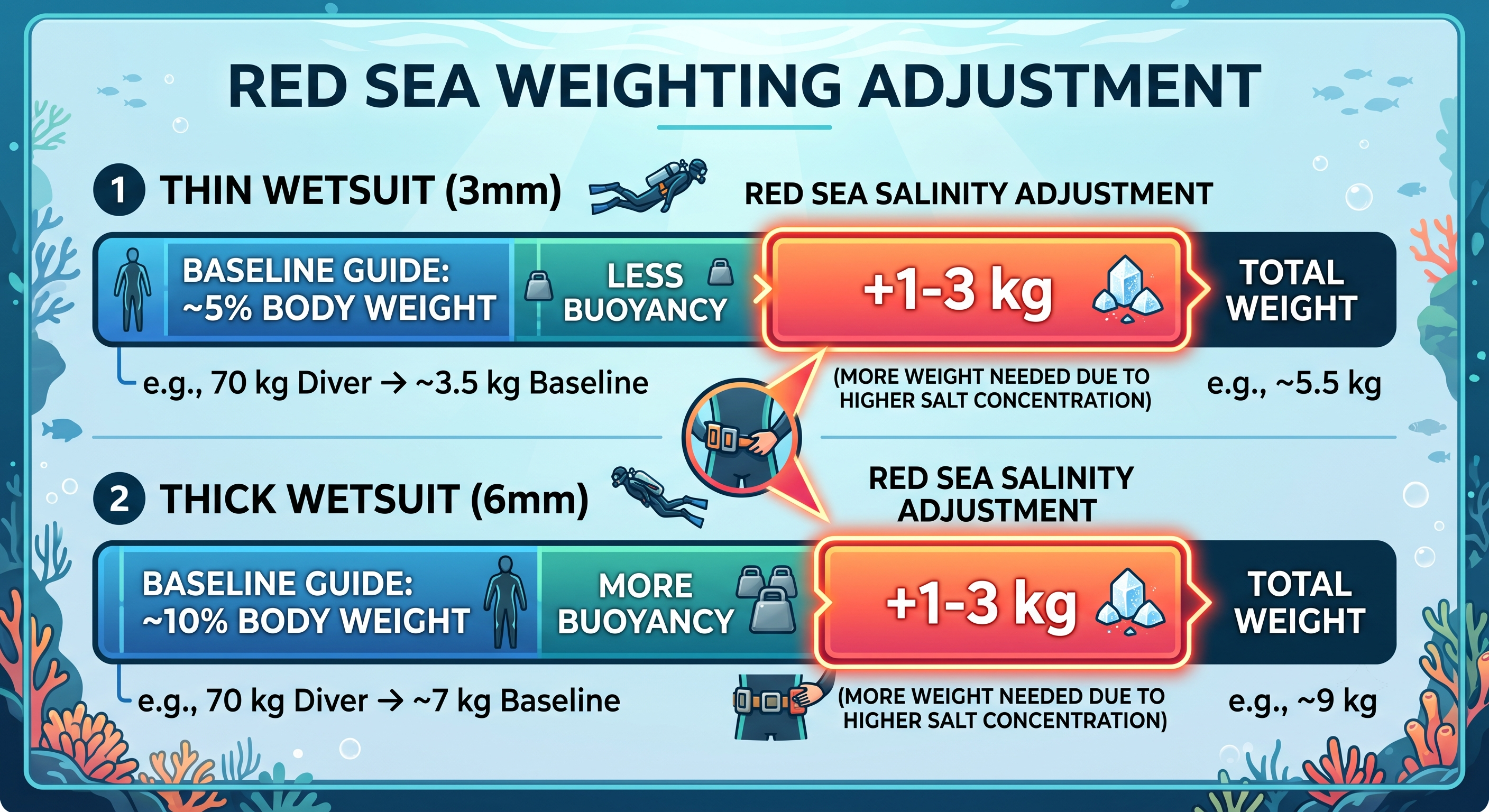
Most divers need 5 to 10 percent of their body weight in saltwater, with thicker wetsuits requiring weight at the higher end of that range. This number is only a starting point, not a rule. A common guideline suggests roughly 5 percent of body weight for a 3mm wetsuit and around 10 percent for a full 6mm suit in saltwater. Thicker neoprene traps more air, and that air makes you float more, so you need more lead to offset it. Tank material matters too. Steel tanks are denser than aluminum ones, so divers using steel tanks typically need less added weight than those using aluminum. Body composition plays a role as well. None of these numbers are exact for every diver, which is exactly why the next tip matters.
2. Add Extra Weight for the Red Sea's Salinity
The Red Sea is saltier than average ocean water, so most divers need 1 to 3 kg more weight to stay neutral.
This is the single most overlooked adjustment for divers new to the region. Saltier water is denser water, and denser fluid produces more upward buoyant force on anything submerged in it. That means you float more easily in the Red Sea than you would in a lot of other diving destinations, even if you're using the exact same gear.
Divers who skip this adjustment usually find out the hard way. They struggle to descend, then overinflate their BCD to compensate, which drags them off balance and burns through air faster. Experienced Red Sea divers generally add about 3 to 5 percent more weight than they'd use in standard seawater, often 1 to 3 kg extra.
For context, one analysis calculated that a 237-pound diver would need roughly 8.3 pounds of extra weight to offset a 3.5 percent salinity difference compared to average ocean water.
Pro Tip: If you normally dive in 5mm neoprene at, say, 8 kg of lead back home, plan to test with 9 to 11 kg here before you commit to a full day of diving. It's a lot easier to drop a kilo on the surface than to fight overweighting for an hour underwater.
If you're building your skills from scratch, Blue Reef's Discover Scuba Diving course is a good place to get weighting dialed in with an instructor watching closely.
3. Run a Proper Pre-Dive Buoyancy Check
Descend to about 6 meters with a near-empty tank, and if you hover neutrally after a normal exhale, your weighting is correct.
Generic percentage rules only get you close. The pre-dive buoyancy check is the definitive way to confirm your actual weight needs for that day, that gear, and that body of water. Here's how it works in practice. Get to roughly 6 meters (20 feet) in saltwater with a tank that's close to empty.
Breathe normally, then let out a regular exhale. If you're properly weighted, you should hang there, neither sinking nor floating up. Run this check every time your setup changes. New wetsuit, new tank, new travel destination. All of these shift the numbers, and salinity differences between dive locations are one of the most common reasons a check that worked last week suddenly doesn't work today.
4. Fix Your Trim, Not Just Your Total Weight
Getting your total weight right solves half the problem. The other half is where you put it. A diver can be perfectly neutral overall and still float badly, tilted head-down with legs sinking toward the reef. This happens most often when all the weight sits on a traditional belt around the waist, which pulls the lower body down and creates a vertical, feet-first posture.
The fix is distribution, not just quantity. Integrated BCD weight pockets, V-weights mounted on a backplate, or small trim weights placed low on the body all help balance the natural buoyancy of your torso and head.The goal is a horizontal position, floating parallel to the seafloor rather than at an angle. Good trim isn't about looking sharp in photos, though it does that too. It cuts drag, makes finning far more efficient, and keeps your fins well clear of the coral below you.
If your current setup keeps pulling your legs down no matter how you adjust your total weight, try moving some of that lead from your belt to trim pockets or a backplate system before your next dive. A simple way to check your own trim is to have your buddy watch you from the side during a dive, or ask your instructor to film a few seconds of you swimming. Seeing yourself from outside makes the head-down posture obvious in a way it never feels from the inside. Small adjustments, moving a kilogram from your belt to a trim pocket near your tank valve, for example, can shift your whole body position without changing your total weight at all.
5. Use Your Breath as a Buoyancy Tool
Every inhale adds lift and every exhale removes it, so slow breathing lets you adjust depth without touching your BCD.
This is the part most guides gloss over. Every exhalation decreases buoyancy slightly while every inhalation increases it, which means your lungs are essentially a built-in buoyancy control device you're already carrying. Instead of reaching for your inflator every time you drift a foot off the reef, try a slightly deeper inhale to rise or a fuller exhale to settle back down.
The habit to break is breath holding. New divers sometimes hold their breath when they're concentrating hard, which is understandable but counterproductive. Replacing that instinct with continuous, slow, rhythmic breathing gives you far more stable, predictable control over your position in the water.
Did You Know? A full lung of air can shift your buoyancy by roughly a kilogram compared to a full exhale, which is more than enough to lift or settle you a meter or two without inflating your BCD at all.
6. Practice Diaphragmatic Breathing on Land First
Deep, belly-driven breathing does two jobs at once underwater. It regulates lung volume for those fine buoyancy adjustments, and it activates your parasympathetic nervous system, which promotes relaxation and lowers stress. The problem is that this kind of breathing doesn't come naturally under pressure, literally and figuratively, if you've never practiced it.
The fix is simple. Spend a few minutes a day on land breathing slowly through your diaphragm rather than your chest. Practicing this on land builds the habit and strengthens the mind-body connection you'll rely on for relaxed, controlled diving. By the time you're underwater, it should feel automatic instead of like one more thing to think about.
7. Manage Anxiety Before It Wrecks Your Control
Anxiety triggers hyperventilation and impaired focus underwater, which directly destabilizes your buoyancy, so treat calm breathing as a core safety skill rather than an extra. This connection gets underplayed constantly. When a diver feels anxious, their body triggers a stress response that often leads to hyperventilation and rapid, shallow breathing. That shallow breathing wrecks the fine buoyancy control we just talked about, because you can no longer make small, deliberate adjustments with your breath. It also chips away at your focus and decision-making right when you need both. Divers Alert Network treats this seriously enough to flag anxiety as a known contributor to diving incidents and a factor worth managing before it escalates. If you notice your breathing speeding up, that's your cue to slow down, check in with your buddy, and give yourself a minute before continuing. A good instructor should be watching for this too, which is one reason a supportive team matters as much as your gear does. At Blue Reef, our instructors are trained to spot early signs of stress and slow the pace down before it becomes a problem.
8. Make Small BCD Adjustments, Not Big Ones
One of the most common beginner mistakes is overcorrecting. You start sinking, so you hit the inflator for a full second, then shoot up too fast and have to dump air just as aggressively. This yo-yo pattern burns air and wears you out. The better approach is short bursts. Add a small puff of air, wait a few seconds to see how your body responds, then adjust again if needed. Buoyancy changes aren't instant, so give each small adjustment time to settle before making the next one. Combine this with the breath control from Tip 5 and you'll find you need the inflator far less often than you think. New divers often reach for the inflator out of habit rather than actual need. Before pressing the button, pause and ask whether a slightly deeper breath would solve the problem instead. Save the BCD for larger adjustments, like settling in at the start of a dive or compensating after a long fin kick, and let your lungs handle the small stuff.
9. Compensate for Gas Loss Through the Dive
As your tank empties it gets lighter, so you'll likely need small BCD deflations later in the dive to stay neutral. Your weight needs at the start of a dive aren't the same as your weight needs at the end. A full tank is heavier than a nearly empty one, and that difference shifts your buoyancy gradually over the course of the dive. This is one reason the pre-dive buoyancy check from Tip 3 specifically uses a near-empty tank. It reflects the hardest part of the dive to control, the last few minutes before your safety stop, when you're lightest and most likely to drift upward if you're not paying attention. Expect to let a little air out of your BCD as the dive goes on, especially in the final stretch. If you were dialed in perfectly at the start but feel yourself creeping upward near the end, that's gas loss, not a mistake in your original weighting.
10. Handle Red Sea Currents Without Losing Position
In current, stay low and streamlined, use the reef or seabed as a visual reference point, and conserve energy instead of fighting the flow. Currents raise the stakes on everything covered so far. Good trim and calm breathing matter even more when water is pushing against you. Fighting a current head-on wastes air fast and makes fine buoyancy control nearly impossible, since you're focused on forward progress instead of position. Instead, work with the current rather than against it, using drift diving technique to stay stable while conserving energy.Keep your body streamlined and close to horizontal trim, use the reef structure as a visual anchor for your depth, and avoid sudden fin movements that burn energy without adding control. Some of Blue Reef's Red Sea dive sites are known for stronger currents, so this is worth practicing on calmer dives first.
Pro Tip: When a current picks up, drop slightly lower in the water column near the reef structure rather than fighting it at mid-water. You'll find a natural wind shadow effect that makes holding position much easier.
11. Protect the Reef With Tighter Trim Control
Good buoyancy isn't only about your own comfort. It's also how you avoid damaging the environment you came to see. Divers with poor trim, especially the head-down posture covered in Tip 4, are far more likely to brush coral with their fins or kick up sediment that smothers nearby reef life. Maintaining precise trim and avoiding any contact with coral is one of the clearest ways a diver can protect fragile reef ecosystems during a dive. This matters everywhere, but it matters especially in the Red Sea, where coral growth is slow and recovery from physical damage can take years. Treating trim as a conservation skill, not just a comfort one, changes how carefully most divers approach it. A useful habit is keeping at least an arm's length of distance from any reef structure, even when you're confident in your trim. Currents, surge, and other divers nearby can all push you closer than planned, and that buffer gives you room to correct before contact happens. Divers who make this a default habit tend to protect reefs even on the dives where their trim slips a little.
12. Watch for Fatigue on Multi-Dive Days
Repetitive dives in a single day build cumulative fatigue that dulls focus and motor control, both of which you need for good buoyancy. Multi-dive packages are common in the Red Sea, and they're a great way to see more dive sites in less time. But diving in demanding conditions across several dives in one day can lead to cumulative fatigue that impairs cognitive function and motor skills, which are exactly the skills buoyancy control depends on. You might nail your trim and breathing on dive one, then find yourself sloppy and overcorrecting by dive three. The fix isn't complicated. Pace yourself, hydrate between dives, eat something if you're running low on energy, and don't be afraid to sit out a dive if you're feeling worn down. A tired diver with great technique on paper can still struggle with buoyancy in practice, so treat rest as part of your gear checklist, not an afterthought.
Putting It All Together
Buoyancy control isn't one skill, it's three working together: correct weight, smart weight placement, and calm, deliberate breathing. In the Red Sea specifically, that means starting with a solid baseline, adding weight for the region's high salinity, checking it properly before every dive, and staying aware of how currents, reef proximity, and fatigue all place extra demands on your control. None of this clicks all at once. It's a skill you build dive by dive, with small adjustments that add up to something that eventually feels effortless. If you want to work on it with an instructor who'll watch your trim and weighting closely, book a daily dive package with Blue Reef and put these tips into practice on an actual Red Sea reef.
Frequently Asked Questions
How much extra weight do I need for the Red Sea specifically? Most divers add roughly 1 to 3 kg (about 2 to 6 lbs) beyond their normal saltwater weight to offset the Red Sea's higher salinity. What's the difference between buoyancy and trim? Buoyancy is whether you float, sink, or hover in place. Trim is your body's angle in the water, ideally horizontal rather than head-down or feet-down. Why do I keep sinking or floating during a dive? It's usually incorrect total weight, gas loss changing your buoyancy over time, or breath holding disrupting your natural adjustments. Can breathing technique really change my buoyancy? Yes. A full inhale adds lift and a full exhale removes it, so slow, controlled breathing lets you fine-tune your depth without touching your BCD. How many dives does it take to get good at buoyancy control? There's no fixed number, but most divers see real improvement within 10 to 20 dives of focused practice on weighting and trim, and it keeps sharpening with regular diving after that.

Leave a comment